Anne Lindberg and H. L. Hix: Threads
by Hearne Pardee
November 2026
The Brooklyn Rail
Threads, the latest exhibition at ‘T’ Space, extends architect Steven Holl’s collaborative explorations of art, poetry, music, and architecture. Perhaps unique in ‘T’ Space’s 16-year history is the extent to which the current collaborators directly engage with each other and with the architecture of Holl’s Archive Gallery in Rhinebeck. Visual artist Anne Lindberg stretches colored cotton threads from wall to wall, and poet H. L. Hix mounts on them his own “threads” of poetic text. Perched on a wooded ridge, the gallery, an elongated trapezoid based on the golden mean, is animated by light from doors and skylights, which intervene dramatically in Lindberg’s arrays of threads. Two skylights near the center of the longer west wall are countered by a door opposite them in the east wall, which opens onto a glass-enclosed viewing platform and overlooks the surrounding woods, an essential context. Lindberg takes advantage of this design to situate two thread arrangements on either side of that door, slanted upward as though drawn to the opening. In Hix’s words, “Connecting limit to limit, these threads manifest space.” Some 2,400 filaments are held in tension by pairs of staples at each end, which produce intriguing patterns of dimpled shadows on the white walls, like swarms of bees. Yellow threads predominate in the central zones, while bluish-white strands soften the edges, enhancing the effect of sunlight penetrating through the misty atmosphere, as in one of Martin Johnson Heade’s Luminist landscapes. Lindberg and Hix cite Heade, along with Agnes Martin, as influences. Viewers gaze through this mist-inflected landscape towards the distant south wall where a large square window frames another view of rocks and woods. On sunny days, deep skylights on the northeast and southwest corners of the gallery contribute intimations of the sublime to this cloudscape, as light falling through their angled openings generates bright, irregular geometric shapes in the corners of the gallery.
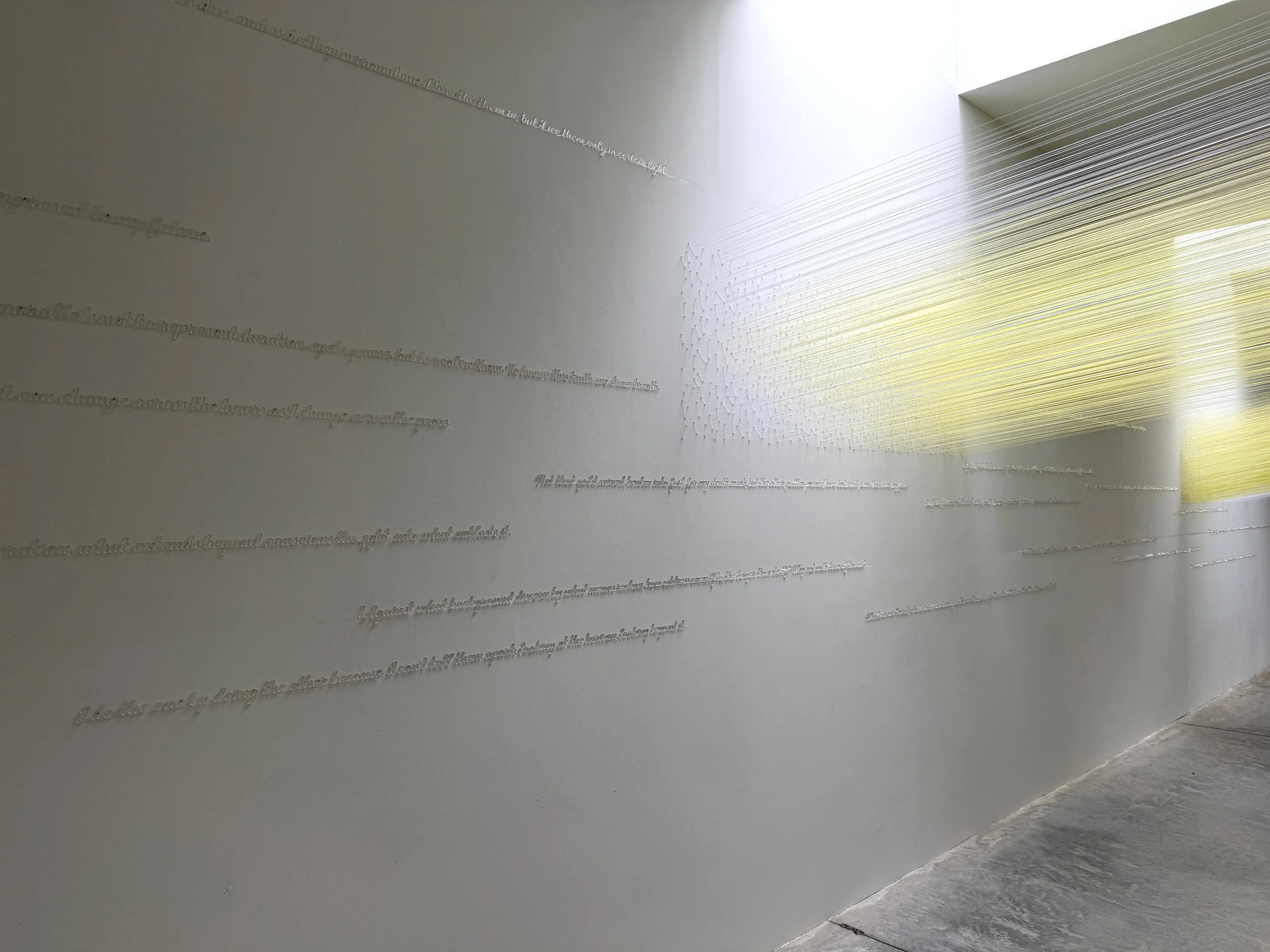
Installation view: Anne Lindberg and H. L. Hix: Threads, T-Space, Rhinebeck, NY, 2026. Courtesy T-Space. Photo: Derek Porter
Hix draws attention to the limitations of language, citing the observation of Ludwig Wittgenstein that “what can be shown cannot be said,” but he contributes words in two ways to this immersive collaboration, which he frames conceptually as “larger than itself”:
Whole in one thread, whole in all, luminosity holds secret some larger than itself that no other than itself could tell.
The larger than itself never reveals itself in the world or as itself. Hushed, it lets on only that it is, not what.
Against what background discern, by what means reckon, how address oneself to, the larger than itself? Why not with lines of thread?
Selecting words from an extended series of call-and-response email exchanges with Lindberg, Hix has distilled them into lines, “threads” of thirty syllables each (longer than the conventional poetic line) in response to the length of her cotton ones. Transcribed into flowing script and laser-cut in clear Plexiglas, his threads are conceptually standardized but varied in length, due to the differing lengths of the specific words they contain.
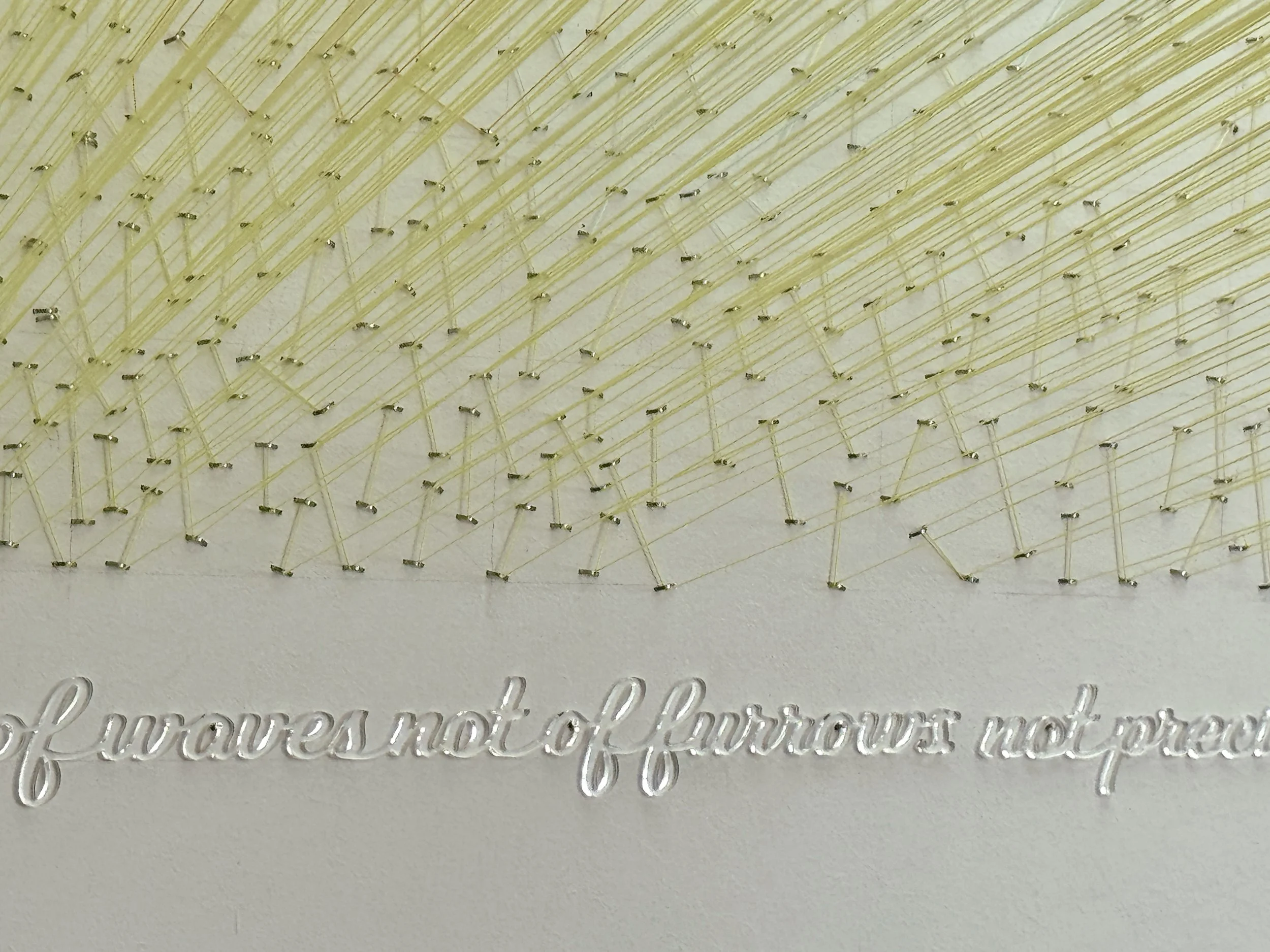
Installation view: Anne Lindberg and H. L. Hix: Threads, T-Space, Rhinebeck, NY, 2026. Courtesy T-Space. Photo: Derek Porter
In Projective Verse (1950), poet Charles Olson advocated for the poem as a field of free invention, liberated from the structured lines of “closed” verse. Generated by breath, projective verse demanded reconsideration of the syllable and line. Olson’s “open field” is closer to Abstract Expressionism than to the minimalism of Agnes Martin, but in the gallery, Hix’s self-imposed conceptual structure places his concrete observations—on the wings of a Mayfly or the drama of a clothesline—in the sort of overall interactions that Olson envisioned, where they address both the metrics of Holl’s architecture and the light and shade of Lindberg’s luminist landscape. Lindberg, responding to the words, has mounted the Plexiglas strips in staggered horizontal arrays around the gallery, introducing a linear impulse that involves the viewer physically with its demand to be read. They assume a proprioceptive engagement with language through bodily movement as viewers adjust their posture to changing levels, which begin at eye level opposite the entrance with “Luminosity: to be washed through by the same limitlessness one passes through: for these threads, space and time; for my life, life,” and are lowest on the far wall by the window.
Reflected light on Plexiglas both complicates the reading (a full print transcription is available) and creates an eye-catching interplay of incidental glints across the shadowy interior. Viewers encounter words in passing glimpses, as we often interact with language in daily life, yet the staggered arrays generate a continuous flow, like a stream over rocky ledges, that also acknowledges the geometric enclosure of Holl’s construction. Animated by glimmers of light, it evokes, for all its artifice, the impossible dream of a “natural” poetic language, connecting the luminous mesh of Lindberg’s taut threads to the actual rocks and woods “depicted” in the gallery’s windows.
Hearne Pardee is an artist and writer based in New York and California. He is Professor Emeritus at UC Davis.