
Exhibition catalogs for last summer’s Lost and Proud show with the River Valley Arts Collective are now available in print! Thanks to Nori Pao for a beautiful digital design that is now available via the LuLu bookstore.
Lost and Proud was an exhibition featuring work by Liz Collins, Katie Ford, Anne Lindberg, and Laurel Sparks that took place in Newburgh in May 2020. The exhibition was inspired by the historical great Lenore Tawney. We hoped to gather people together for a symposium. This publication became the alternative means for sharing ideas when events were not possible.
Featuring texts by Allyson Baker, Candice Madey, Jennie Goldstein, Shannon Stratton and Karen Patterson.
Thank you to the artists and writers and to the Lenore Tawney Foundation for making this possible!
#rivervalleyartscollective

Anne Lindberg, cycles of seeing 01, graphite and colored pencil on mat board in 2 panels, 34 by 116 inches, photograph by Derek Porter
"cycles of seeing" drawing intervention opens to public July 10 at Manitoga, Garrison, NY
2020 ARTIST RESIDENCY - ANNE LINDBERG
The Artist Residency program was initiated in 2014 to foster creative responses to Manitoga that invoke Russel Wright's legacy of creative experimentation and celebration of place.Manitoga / The Russel Wright Design Center is pleased to announce year seven with presentations of work by New York based artist Anne Lindberg and British composer Pete M. Wyer. Anne Lindberg’s luminous large-scale drawings cycles of seeing will be installed in the main House beginning July 4 while Wyer will create an immersive sound installation in the landscape this summer as part of his evocative iForest series through September 26. Both works find inspiration in and community with Nature at Manitoga as Russel Wright did from the moment he took stewardship of this sacred land.
cycles of seeing by Anne Lindberg
On view with Tour Participation through November 9, 2020 and during special programs and events. Purchase Tickets at BrownPaperTickets.com beginning June 15, 2020.
At Manitoga, Wright was keenly aware of the seasonal cycle and rhythms of nature, of the daily and often barely perceptible changes in color and light in the landscape and within the house. Nature was the inspiration for Manitoga’s design, and it framed the rituals of every day life here as woodland footpaths followed the arc of the sun and the home’s furnishings and wall panels changed with the turn of season.
In her two-part drawing series cycles of seeing, Lindberg’s palette of thousands of colored parallel lines will transition from cool to warm as summer becomes fall at Manitoga, reflecting concerns of time, sequence and causality. Lindberg’s works unfold at the pace of her step as she pulls lines across a pliant mat board, and she finds context for her work within a long tradition of other “walking artists” including William Wordsworth, Rebecca Solnit, and Virginia Woolf. “Like these artists, philosophers and writers, I use walking as time to encourage a fluid state of perceptions, to contemplate place, and to affect change and adaptation as it informs incremental, moment-to-moment decisions in the making of my work.
”To Lindberg’s list of walking artists, we might add Russel Wright who routinely walked his seventy-five acres of woodlands over many years, observing, mapping and refining Manitoga’s footpaths and trails and placing his house and studio as part of a mindful and orchestrated movement through and dialogue with nature. Lindberg’s deliberate and measured pace informs the scale of her work as Wright’s was the measure of Manitoga.

Lost and Proud, installation view at Thornwillow, Newburgh, NY - curated by Candice Madey with artists: Liz Collins, Katie Ford, Anne Lindberg and Laurel Sparks
Lost and Proud is open at the Thornwillow Institute in Newburgh, NY - curated by Candice Madey
Lost and Proud
Liz Collins, Katie Ford, Anne Lindberg & Laurel Sparks
open by appointment through River Valley Arts Collective from May 23 - June 21, 2020
Thornwillow Institute
7 Lander Street
Newburgh, NY 12550
River Valley Arts Collective is pleased to announce Lost and Proud, an exhibition of painting, drawing and photography by Liz Collins, Katie Ford, Anne Lindberg, and Laurel Sparks, artists who integrate techniques traditionally employed in weaving and fiber art in to their studio practices. This exhibition and related activities will take place at The Thornwillow Institute in Newburgh, New York, an organization committed to promoting and perpetuating the art of craftsmanship in all its forms.
The exhibition’s title Lost and Proud cites a seminal work by pioneering fiber artist Lenore Tawney (1907-2007). Tawney challenged the technical conventions of weaving that she had been taught at the Penland School of Crafts in the early fifties, inventing a process she named “open warp,” in which erratic-weft threads illustrate a strong relationship to drawing.
Here, we explore various approaches to process and gesture through the lens of Tawney’s legacy of proficient materiality and innovation in the work of four Hudson Valley artists—Liz Collins, Katie Ford, Anne Lindberg, and Laurel Sparks. Like in Tawney’s open warp tapestries, these artists rarely adhere to rigid expressions of the grid, embracing instead more fluid and improvisational compositions. The exhibition also considers the relationship between line and thread, with works on paper that relate to the qualities of textile. The title Lost and Proud suggests a confident and experimental mode of working, typified by each of these artist’s inquisitive and open-minded approach to their practice.
In conjunction with the exhibition, River Valley Arts Collective has produced a digital publication that explores Lenore Tawney’s legacy alongside the contemporary art practices of the exhibition’s artists, with newly commissioned texts by Karen Patterson, Curator, Fabric Workshop and Museum; Jennie Goldstein, Curator, Whitney Museum of American Art; and Shannon Stratton, Executive Director, Ox-Bow School of Art.
River Valley Arts Collective was founded by Alyson Baker in January of 2019, and is currently presenting itinerant programming in the Hudson Valley while working to secure and equip a permanent location. As goals are fully realized in the coming years, it will provide artists with the resources to create and present their work and host programs that connect and foster the creative community of our region. Central to River Valley Arts Collective will be an exhibition venue alongside three expansive communal studio spaces outfitted with tools and equipment for work in fiber, wood and clay, available to artists of the Hudson Valley and artists who are participating in area residencies.
River Valley Arts Collective is grateful for generous support from: The Al Held Foundation, Athena Foundation, Atlas Studios, Mark Dion, Kristen Dodge, John B. Koegel, Esq., The O’Grady Foundation, Clay Rockefeller, Richard Salomon Family Foundation, and The Lenore G. Tawney Foundation, and Luke Ives Pontifell, The Thornwillow Institute.
Lost and Proud is curated by Candice Madey. For more information, please contact info@RVACollective.org.

Anne Lindberg, insomnia 21, 2008 ink on vellum pressure-adhered to archival pigmented print, 28 by 34 inches

Lenore Tawney: Mirror of the Universe, co-published by John Michael Kohler Art Center and University of Chicago Press
Lenore Tawney: Mirror of the Universe, by Karen Patterson with essays by Glenn Adamson, Kathleen Nugent Mangan, Mary Savig, Shannon Stratton and Florica Zaharia, copublished with John Michael Kohler Art Center and University of Chicago Press, 2019
I’m pleased to have work included in this beautiful book published on the occasion of the multi-exhibition project at the John Michael Kohler Art Center called Lenore Tawney: Mirror of the Universe.
My work was included in Even thread (has) a speech, a group curated by Shannon Stratton. Artists included: Indira Allegra, Julia Bland, Jesse Harod, kg, Judith Leeman, Anne Lindberg, Michael Milano, and Sheila Pepe.

Anne Lindberg, At first the visible obscures., 2019, thread and staples, 9 by 26 by 2 feet, title is from Theodore Roethke’s poem Unfold! Unfold!, photograph by Derek Porter

Anne Lindberg, At first the visible obscures., 2019, thread and staples, 9 by 26 by 2 feet, title is from Theodore Roethke’s poem Unfold! Unfold!, photograph by Derek Porter

Anne Lindberg, insomnia 19, 2008, colored pencil on vellum over archival pigmented print, 28 by 34 inches
SĪMURĞ, curated by Muriel Quancard at Josee Bienvenu Gallery opens Thursday Nov. 20, 2019 through Jan. 18, 2020
SĪMURĞ
curated by Muriel Quancard
Artists: Hope Atherton, Nicolas Baier, Frank Dufour, Gonzalo Lebrija, Anne Lindberg
A new life flow towards them from that bright
Celestial and ever-living light -
Their souls rose free of all they had been before;
The past and all its actions were no more.
There in the Simorgh 's radiant face they saw
Themselves, the Simorgh of the world - with awe
They gazed, and dared at last to comprehend
They were the Simorgh and at the journey's end.
- The Conference of the Birds, Farîd-ud-Dîn Attâr
Can a 12th century Sufi poem coexist with a group of contemporary artworks and heighten the perception of Western art forms? The experiment attempted here is an overlay of literary references, traditional techniques, various media and technologies. Four bodies of works —by Hope Atherton, Nicolas Baier, Gonzalo Lebrija, and Anne Lindberg—resonate with Farîd-ud-Dîn Attâr’s epic allegory of Islamic Sufi mysticism, The Conference of the Birds. Each body of work forms a unique cosmography that chimes with aspects of this allegorical tale. An auditory experience, conceived by Frank Dufour of the collective Agence 5970, compels the visitor to delve into their mysteries.
Attâr’s poem is an esoteric quest for truth following the birds of the world on a journey as they seek the king of birds, the Simorgh. The hoopoe offers to lead them to Mount Qaf, a green emerald mountain surrounding the earth, where the Simorgh live. The birds fly across seven valleys: quest, love, knowledge, detachment, unity, wonderment, and annihilation. After various trials, just thirty birds overcome suffering and reach spiritual enlightenment; When they arrive at Mount Qaf, the exhausted and depleted birds, realize that the Simorgh, which in old Persian means thirty (si) birds (morgh), is a reflection of themselves. The powerful bird is hidden in each of them and they all together, in unity, are the Simorgh.
In his “Veladuras Nocturnas” paintings, Gonzalo Lebrija achieves spatial depth with a traditional glazing technique involving the application of multiple layers of translucent and iridescent paint over an opaque underlayer. The painting’s geometric shapes are based on origami paper planes reminiscent of childhood memories. Evocative of cones of light, they recall the cosmic landscape of Mount Qaf, where the invisible is revealed.
Anne Lindberg’s diaphanous installation also summons a dimension in which the corporal becomes ethereal. The artist has stretched a multitude of threads across a corner of the gallery which brings to mind a flock of birds. The aggregation of lines seems to dissolve the space while creating a sense of velocity, reminding us that space and time are embedded in a continuum. Presented on another wall, her “insomnia drawings” evoke landscapes from a bird’s-eye view. The artist drew serpentine lines on vellum that is laid atop photographs of her bed taken each morning upon waking; a process that resulted in subtle topographical reliefs.
Nicolas Baier’s bas-reliefs from the “Constellation” series depict arbitrary connections between the stars from a non-terrestrial vantage point. He creates cartographies based on coordinates issued by astronomical databases such as the Bright Star Catalogue. The stars connected via an algorithm form random constellations. These topographies are carved in high-density foam with a CNC (computer numeric control) machine and coated with brass or with meteorite graphite.
Hope Atherton resorts to ancestral techniques to create sculptures that point toward nontraditional temporalities. Due to their elemental qualities, they occupy a site of possibility between the past and future. Two birds coalesce in an enigmatic posture so as to form one mass. Their vulnerability recalls the trials encountered by the birds in Attar’s poem and the ultimate transformation that followed.
Translated by Dick Davis and Afkham Darbandi
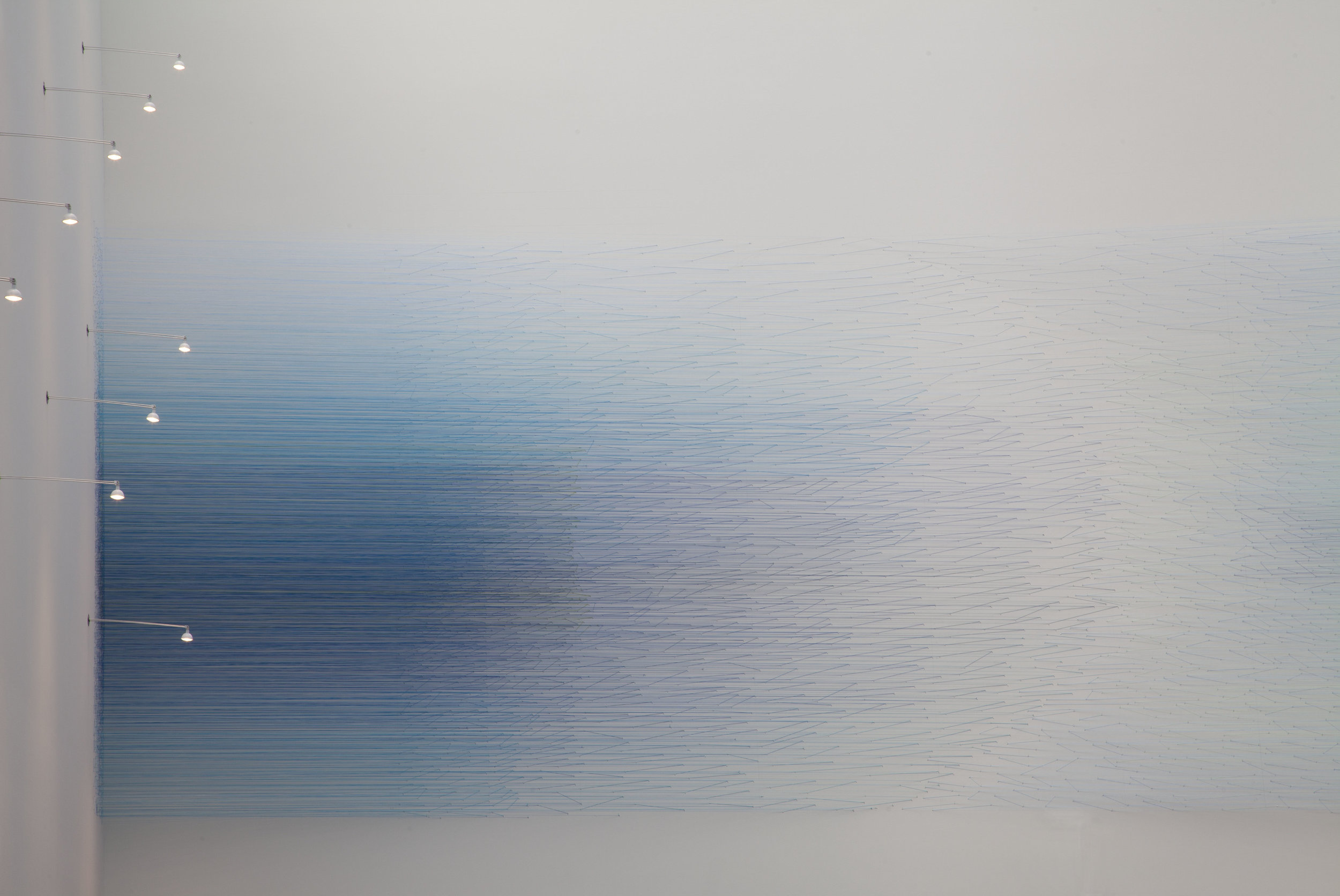
Anne Lindberg, “At first the visible obscures:” thread and staples, 9 by 26 by 2ft - title is from Theodore Roethke’s poem Unfold! Unfold!
Even thread (has) a speech opens at John Michael Kohler Art Center September 1st
Even thread [has] a speech examines how contemporary artists working in fiber materials and processes have inherited and broadened Lenore Tawney’s (1907–2007) groundbreaking experiments in the field.
Featuring works by eight contemporary artists who extend weaving conceptually, this exhibition intersects with architecture, performance, sound, painting, and installation to expand traditional concepts of fiber art, weaving, and structure. The works incorporate approaches that deconstruct, perform, explode, or compress the qualities that informed Tawney's practice and underpin textile and weaving histories.
Even thread [has] a speech showcases new, site-specific installations commissioned by the John Michael Kohler Arts Center as well as 2-D and 3-D artworks by Indira Allegra, Julia Bland, Jesse Harrod, kg, Judith Leemann, Anne Lindberg, Michael Milano, and Sheila Pepe. The exhibition is curated by Shannon R. Stratton.
Artists Julia Bland, Michael Milano, and kg are in close dialog with weaving as a format for picture making, coding, narrative, and symbolism. Each explores the discipline's structure and process through gestures that pull focus onto the structure of weaving as the grounds for conceptual, personal, and speculative content.
The open-weave structures of Julia Bland and kg’s large-scale weavings also take the woven form to its technical limits. Additionally, many of kg's small weavings echo Tawney’s in their use of found materials while Bland's embedded shapes alluding to archetypal symbols resonate with Tawney's. Milano’s drawings and works on cloth reference weave patterns and structure as a constraint for minimalism, bringing attention to the tension between both the limits and the expansive possibilities inherent to a binary system.
Judith Leemann's text-based work emerges from training and teaching in fiber studies. She distills textile's root in “text” into sound- and print-based work that uses the word as metaphorical warp-and-weft. Indira Allegra’s interdisciplinary practice, including video, assemblage, and performance. Her work investigates the warp and weft of the loom as the crossing of two competing forces under tension, building on this tension conceptually to explore social, political, and personal experiences of haunting and memorializing.
Artists Anne Lindberg, Jesse Harrod, and Sheila Pepe explore fiber's sculptural and architectural capacities. For Even thread [has] a speech, they created new site-specific installations that emphasize the material qualities of fiber as a means to produce work that is powerfully physical and affective. Elements of light, space, and color, exemplified in Tawney’s work, are foundational in the work of Anne Lindberg, whose site-responsive installations use thread pulled taut through space to create a luminescent color field. Pepe’s crocheted installations connect histories of craft and feminism to reimagine familiar spaces such as the church, the home, and the corporate lobby, while Harrod’s macramé sculptures act as large-scale support structures for queer-identifying bodies.
Even thread [has] a speech is one of four exhibitions in the John Michael Kohler Arts Center’s fall 2019 series, Lenore Tawney: Mirror of the Universe. The series explores Lenore Tawney's life and impact, offering a personal and historical view into her entire body of work. Visit jmkac.org/LenoreTawney for more information about the series.
Lenore Tawney: Mirror of the Universe is supported in part by The Andy Warhol Foundation for the Visual Arts and the Lenore G. Tawney Foundation. Additional support is provided by the Wisconsin Arts Board with funds from the State of Wisconsin and the National Endowment for the Arts.
Curated by Shannon Stratton

Anne Lindberg, I begin with the river, 2019, graphite and colored pencil on mat board, 11 panels, 9 by 25ft, titled from think like the river poem by Ginny Threefoot
Nowhere and Everywhere opens at SEPTEMBER gallery in Hudson, NY Saturday August 28, from 6-8pm
Nowhere and Everywhere
SEPTEMBER is pleased to present Nowhere and Everywhere featuring the work of Sarah Braman, Anne Lindberg, and Mary Ellen Strom.
Nowhere and Everywhere* is an exhibition of three major works; Sarah Braman’s glass, steel and wood sculpture, July Dinner, occupies the northeast corner of the gallery, Anne Lindberg’s multi-paneled drawing, I begin with the river, spans the west wall, and Mary Ellen Strom’s photographic installation,TREE LINES, stretches floor to ceiling on the south wall.
Braman’s work, July Dinner, is a rich, chromatic feast. A brightly stained wooden table is suspended between two densely-saturated glass cubes. The table legs hang mid-air, while the table top extends beyond the weighted embrace. The object in its entirety appears to be a singular column of filtered light, magically bisected by a floating table. How do we give form to the unseen? People once ate at this table, prepared meals on it, held conversations around it. And before its domestic life, this table was once a tree fed by light, rooted in the earth. Its story can only be abstractly traced, its specific history unknown. A table out of context is suspended in the image of itself, allowing projections and memories to be set upon it. July Dinner is a moving history, an embodiment of transience. Braman’s material choice of glass is itself an unfixed, amorphous solid. Wood is also in a state of flux, expanding and contracting in response to its surrounding conditions. In fact, the bulk of the work’s composition- color, light, and air- is ephemeral and ever-changing.
Lindberg’s work, I begin with the river, is a sweeping linear expanse of varying gradient and subtle hue. Thousands of graphite lines traced methodically against the edge of a 10ft parallel bar are layered to build tonal shifts. The changing density of mark making offers a spectrum of opacity, from solid to seemingly transparent passages with soft color slipping behind the graphite. The result is a visual plane that appears to be pulsing outwards and inwards, moving left to right. Eluding focal stasis, the expansive scale of this multi-paneled drawing immerses our perception, creating a sensation of floating. Inspired by the Mississippi River, neighbor to Lindberg’s hometown, the work is a reflection of incrementally subtle, but accumulatively major environmental shifts. The Mississippi River itself is flooding, causing havoc, erasing land. Originally intended to be installed at the Figge Art Museum in Davenport, Iowa, half a mile from the Mississippi River, the work now hangs the same distance from the Hudson River, figuratively tracing the geographic path of the artist’s own life transitions. I begin with the river is a poetic embodiment of nature’s only constant: impermanence. The title of the work is drawn from the poem,think like the river, by Lindberg’s collaborator, poet Ginny Threefoot.
Strom’s work, TREE LINES, is a dramatically rising grid of vibrantly colored trees. Hand-painted and photographed from near and distant perspectives, the seven trees are stacked as composited, disjunctured columns. They appear as incomplete versions of themselves, unable to realign or return to a whole form. From three to ten feet tall, each tree embodies a sense of elongated or truncated time, portraits of individuated subjects with varying lifespans. Discovered in Montana where the artist resides, the trees were found dead standing—the end product of a beetle infested forest. The seven colors generate the NTSC video color bar spectrum, suggesting the possibility of being captured in real time and transformed into moving color. An elegiac gesture or ritual of mourning, TREE LINES is an attempt to re-endow life into something that once was living, and to infuse beauty into a place that is suffering an ugly fall.
Nowhere and Everywhere is an exhibition about depicting the unseen and giving form to impermanence—the memory of an orphaned object, the energy of a flooding river, the life of a dying forest. It is about disjuncture and continuity- lines repeated, forms interrupted. It is about the slow, irreversible passage of time, a longing for that which cannot be kept. And it is about beauty and regeneration: here achieved through color, light, movement, and the artist’s empathy for their subject.
*The title of the exhibition is borrowed from Mary Ellen Strom’s body of work by the same name, Nowhere and Everywhere, about La Cienega de Santa Clara, an oasis amidst dried-out mudflats in the Colorado River Delta of Sonora, Mexico. Her title in turn was selected from Aldo Leopold’s 1948 collection of essays, “A Sand County Almanac” about the Colorado River Delta.
SARAH BRAMAN
Sarah Braman (b. 1970) received a BFA from Maryland Institute College of Art in Baltimore and an MFA from Tyler School of Art in Philadelphia. Solo exhibitions include True Blue Mirror, with Ellen Berkenblit, McEvoy Foundation for the Arts (San Francisco, CA), Growth, Mitchell-Innes & Nash (NYC), Here, Marlborough Contemporary (London), You Are Everything, Mitchell-Innes & Nash (NYC), Sarah Braman: Alive, Museum of Fine Arts (Boston, MA) and Lay Me Down, MACRO (Rome). Braman has also participated in group exhibitions at Crystal Bridges (Bentonville, AR), MASS MoCA (North Adams, MA), the Brant Foundation (Greenwich, CT), Kunsthalle (Helsinki, Finland), The Kemper Museum of Contemporary Art (Kansas City, MO), The Saatchi Gallery (London), among others. Braman is one of the founders of artist-run gallery CANADA in New York. In 2013, she was the recipient of the Maud Morgan Prize from MFA, Boston. She currently lives and works between New York and Amherst, Massachusetts.
ANNE LINDBERG
Anne Lindberg (b. 1962) received her BFA from Miami University in 1985 and an MFA from Cranbrook Academy of Art in 1988. Her work has been in solo and group exhibitions at such places as The Drawing Center (NYC), Tegnerforbundet (Norway), SESC Bom Retiro (Sao Paulo), Nerman Museum of Contemporary Art (Overland Park, KS), Detroit Institute of Art, Bemis Center for Contemporary Art (Omaha, NE), Cranbrook Art Museum (Detroit, MI), Nevada Museum of Art, Spencer Museum of Art (Lawrence, KS), and Kemper Museum of Contemporary Art (Kansas City, MO), the Museum of Arts and Design (NYC), Thomas Cole Historic Site (Catskill, NY), Contemporary Art Museum Raleigh, Akron Art Museum, Josee Bienvenu Gallery (NYC), Schick Art Gallery at Skidmore College, September Gallery (Hudson, NY), Omi International Art Center (Ghent, NY), the John Michael Kohler Arts Center (Kohler, WI), and the Figge Art Museum (Davenport, IA) among others. She is the recipient of awards including a 2011 Painters & Sculptors Joan Mitchell Foundation Grant, a Charlotte Street Foundation Fellowship, two ArtsKC Fund Inspiration Grants, a Lighton International Artists Exchange grant, the Art Omi International Artists Residency, an American Institute of Architects Allied Arts and Crafts award, and a Mid-America National Endowment for the Arts Fellowship. She works in Ancramdale, New York.
MARY ELLEN STROM
Mary Ellen Strom (b. 1970) received her MFA from the University of California, Irvine and is an instructor at the School of the Museum of Fine Arts, Boston. Strom’s work has been presented at the Museum of Contemporary Art (Los Angeles, CA), the Museum of Modern Art (NYC), The Wexner Center for the Arts (Columbus, OH), The Chicago Art Institute (Chicago, IL), The Walker Art Center (Minneapolis, MN), Kansas City Art Institute (Kansas City, MO), The High Museum (Atlanta, GA), Diverseworks (Houston, TX), Archa, Theatro Divaldo (Prague, CZ), Museo de Arte (Mexico City, MX), Temple Bar (Dublin, IRL), Ars Electronica Festival (Linz, AU), Chapter Art Centre (Cardiff, WAL), among others. Strom has received awards including the Rockefeller Foundation, M.A.P. Grants, New York State Council on the Arts, National Endowment for the Arts, National Alliance for Media and Culture, and two New York Performance Awards (Bessie) for “Outstanding Creative Achievement”. Strom was a 1999-2000 artist in the P.S.1 / MoMA National Studio Program. She currently lives and works in Amherst, Massachusetts.
Image: Mary Ellen Strom, TREE LINES (detail), 2013, digital print, 20 x 30 inches
For further information please visit the gallery at 449 Warren Street, Hudson, NY, visit our website at septembergallery.com, or contact Kristen Dodge at kristen@septembergallery.com.
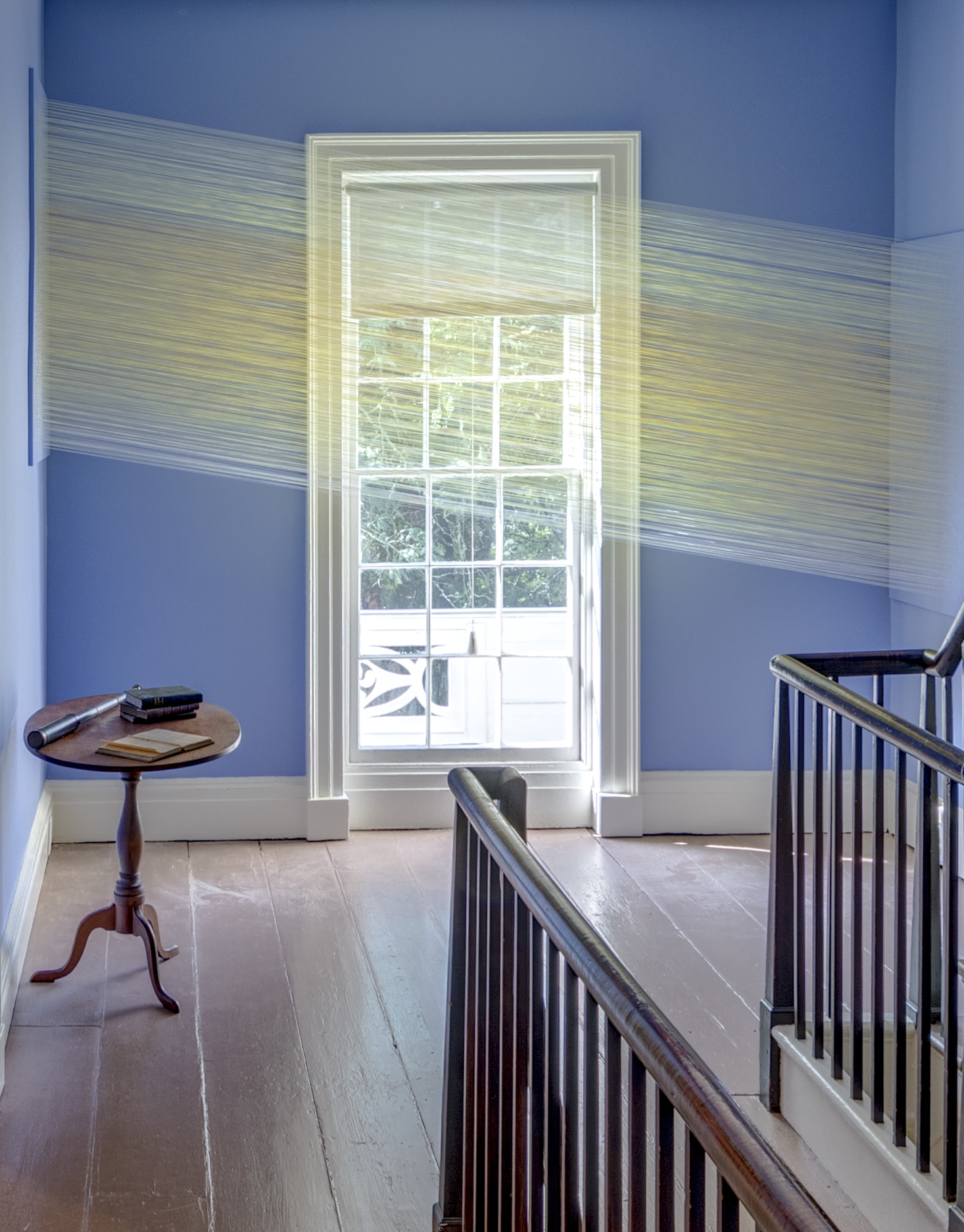
Anne Lindberg, sun come purple, 2018, thread staples at Thomas Cole National Historic Site, Catskill, NY - Photography Credit: © Peter Aaron / OTTO
"Here, Now: Contemporary Art at the Thomas Cole National Historic Site" - June 21, 2019 article by Kate Menconeri on National Trust for Historic Preservation website
Here, Now: Contemporary Art at the Thomas Cole
National Historic Site
By Kate Menconeri
Imagine visiting Thomas Cole at his house in 1840 and standing eye-to-eye with one of his original paintings such as “The Architect's Dream.” Cole, who spent years exploring the Catskill landscapes that inspired his art, hung his own paintings, still wet from the studio, on the walls of his home. Patrons and fellow artists traveled from all over just to see the latest work by the artist who would go on to change the face of American painting. It was not until 2016 that the Thomas Cole National Historic Site, a member of the Historic Artists’ Homes and Studios program, discovered that not only did Cole carefully select the colors of the walls where he hung his work but he also painted exquisite friezes directly on the walls, creating the perfect backdrops for his artworks.
Today the Thomas Cole National Historic Site is simultaneously a historic house, an artist's studio, and an art museum. Given this layered identity, we face a unique set of questions. How do we engage with the vision of the artist, who is now long departed and whose paintings no longer hang on the house walls, but in museums and collections across the globe? How do we activate the ideas and creative momentum that lived here? And why does this artist matter now? At the Cole Site, rather than tell audiences why we think Cole is important, we engage them through the artist's own works and words—culled from his journals, letters, and essays—allowing him to tell his story directly to visitors.
We also consider the relevance of Cole's work through the lens of today’s artists and thinkers. Artistic exchanges, within and beyond the confines of time, can spark remarkable and unexpected things. Cole, who inspired a generation of artists now known as the Hudson River School, was recently in the spotlight when the Metropolitan Museum of Art in New York City presented an exhibition of his work in 2018. Contemporary artists continue to engage with his works, wrestling with some of the same ideas and issues that mattered most to Cole—for example, how to balance the natural and built worlds. Cole advocated for living in harmony with nature and for thoughtful development. He took up his pen and paint brush to speak out against the deforestation that cleared the way for railroads and expanding industry, such as the tanneries that were quickly proliferating throughout the Catskill mountains.
Artists in Conversation Across Time
In 2016 the Cole Site launched “Open House: Contemporary Art in Conversation with Cole,” an annual series of exhibitions featuring contemporary artists. The program seeks to activate conversations among artists across the centuries and explores the continued resonance of Cole’s art and ideas. It sheds light on the connections between 19th-century American art and the present through exhibitions that specifically speak to the historic environment. Each year we invite an artist to create a project—such as a site-specific installation, performance, or guided walk—that engages with Cole’s art, writings, home, or story. Installations and artworks have ranged from those that literally reference Cole’s iconic works to those that expand on the themes with which he wrestled in his own art and writing, such as landscape, environmental preservation, time, history, color, and the sublime.
When we begin planning a project, I ask the artist to consider what they want do here, in Cole’s home, that they can’t do anywhere else. Not only do we want artists to think about Cole and the site’s history but we also want to offer them a chance to create something in this unique context that isn’t possible in a white box or conventional museum gallery. And while we carefully develop each project with the artist, it is often not until the works are physically situated alongside Cole’s original furniture, paintings, and collections that unexpected connections and new conversations come to life.
This was the case in our first installation in the series, Jason Middlebrook’s "Nature Builds / We Cover,” which ran from August through October 2016. We filled Cole’s home with Middlebrook’s hard wood plank paintings as well as an oversized work on paper, “Log Jam on Hudson.” Middlebrook’s work explores the relationship between nature and culture and often blurs lines between landscape and architecture, art and object. Like Cole, he is inspired by a deep interest in time, history, and our inextricable relationship with nature. Middlebrook draws and paints his plank paintings on American hardwoods that are salvaged from a local lumber mill. He paints both with and against the natural grain of the wood, alluding to the complexity of human intervention in the natural environment. The artists’ works prompt questions: How do we harness nature? How do we control it? How do we honor and protect it?
Middlebrook’s intentional use of trees as the canvas itself challenges conventional expectations of what we might consider a landscape, a painting, or a sculpture. The installation of his work in Cole's historic home was towering and awe inspiring, as if a luminous forest had grown overnight. We knew that the installation would offer a space in which to consider the balance between the built and natural worlds, but we were surprised to see how Cole's 180-year old friezes and Middlebrooks painted planks, when juxtaposed together, not only mirrored each other, but offered direct visual connections to nature, as could be seen in the sinewy lines of the honey locust tree just outside the window.
Imagining Catskill Creek and A Spectrum of Color
Artists’ voices and visions are a vital part of the Cole Site’s history as well as its future. Kiki Smith is an artist whose practice crosses mediums. In a visionary approach to art and history, she has created site-specific installations at sites across the world, including at palaces in Italy and in the period rooms of the Brooklyn Museum. Smith's installations are works of art in themselves, with layers of meanings that shift and expand in response to their context. We were thrilled when Smith—who had participated in “River Crossings,” a 2015 group exhibition—decided to create a new multidisciplinary installation in Cole’s home in 2017 for the second annual exhibition in the Open House series. In “From the Creek,” Smith filled the artist’s family home with, among other things, saplings; crystals; and a wild kingdom of animals—deer, bats, owls, turkeys, wolves, and doves—many of which can be spotted roaming the Catskill terrain or the inside of a Cole painting. Smith and Cole, residing “about a mile, and two centuries apart” along Catskill Creek, both made work that is directly inspired by this waterway, which flows from the Hudson River to the Catskill Mountains.
Smith’s work resonates with Cole’s paintings of Catskill Creek as well as his cyclical series, such as “Course of Empire” and “Voyage of Life.” The artists share a fascination with life cycles, the natural world, history, and the fragility and power of the environment. While Cole’s landscapes are epic and sweeping, Smith's focus is on the iconic elements within the natural world and their role in an interconnected whole. Smith deftly integrated her tapestries, prints, sculptures, and sound work into the artist’s home, offering visitors an opportunity to consider these relationships, as well as the regenerative power of nature and art. Through her intentional arrangement of artworks and objects throughout Cole’s home, Smith transformed every space, as if she was awakening something that had been dreaming.
Since her solo project, Smith has become an advisor on the Open House series, and it was from ongoing conversations with her that the third annual Open House project emerged. When artists visit the site, it is Cole’s color wheel, "Diagram of Contrasts,” that often gets the most attention. Cole was fascinated by color for, among other things, its expressive power and relationship to music. He even attempted to invent an instrument that could play the "sound of color". In 2018 we explored this in depth in “SPECTRUM,” an exhibition that brought together Cole’s works—and his extensive writing about color—with works by 11 contemporary artists: Polly Apfelbaum, Valerie Hammond, Ann Veronica Janssens, Anne Lindberg, Laura Moriarty, Portia Munson, Jackie Saccoccio, Lisa Sanditz, Julianne Swartz, Mildred Thompson, and Linda Weintraub. Each artist was invited to present existing artworks or to debut a new installation created for the exhibition. Like Cole, the artists grapple with color as uniquely situated between art and science, as something that speaks to our senses and our reason, and which can open up experiences within and beyond this visual realm. The works in “Spectrum” included everything from paint on canvas to glass optical viewers, a light installation, and a garden. We also displayed Cole’s writing about color, publications of his time, and new writing from artist and researcher Jesse Bransford about the color theories that Cole was exploring in the 19th century.
When Cole painted the walls of his home to be a “perfect backdrop” for art and ideas in 1836, he created a unique and lasting artistic setting. It is our hope to continue to animate his legacy and find meaning in our moment. It remains clear that the power of art and artists to initiate new thinking, complicate, and forge connections remains as relevant and urgent as ever.
Kate Menconeri is the curator and director of exhibitions and collections at the Thomas Cole National Historic Site. For more on the Thomas Cole National Historic Site read "Two 19th-Century Artists’ Homes Shed Light on the Women Who Shaped Them" by Carson Bear on SavingPlaces.org
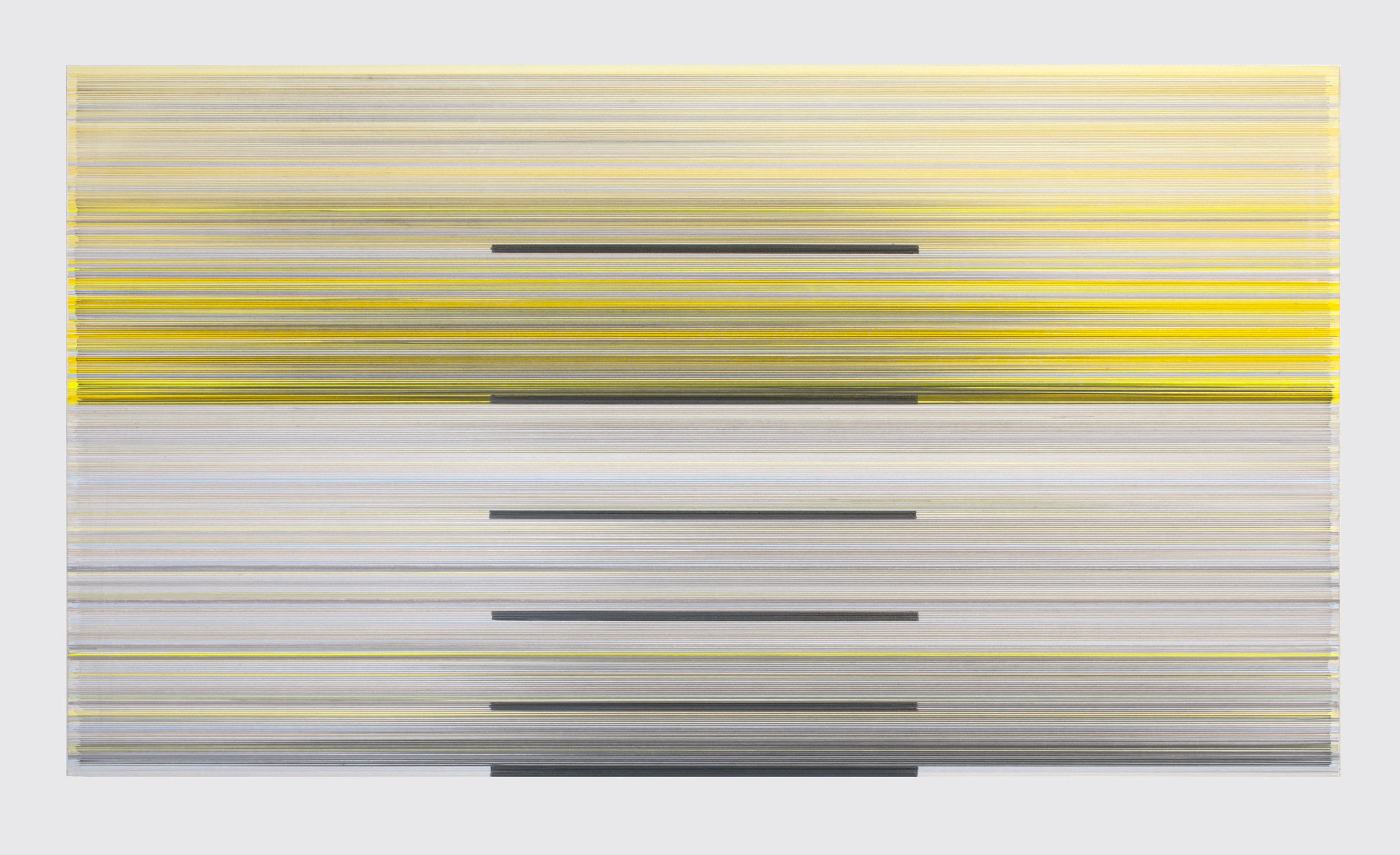
Anne Lindberg, walking east, 2019, graphite and colored pencil on mat board, 24 by 36 inches
Yellow opens at SEPTEMBER in Hudson, NY - Saturday June 22 - August 4, 2019
YELLOW
June 22, 2019 thru August 04, 2019
Opening Saturday, June 22, 2019, 6–8pm
Katherine Bauer, Annie Bielski, Ashley Garrett, Brenda Goodman, Anne Lindberg, Lauren Luloff, Donna Moylan, Michelle Segre, Jackie Saccoccio, Odessa Straub, Kianja Strobert, Amanda Valdez, Sun You, Nicole Wittenberg
SEPTEMBER is pleased to present Yellow, a group exhibition of 14 artists working with the color yellow in subtle or startling ways. Regardless of the surface area occupied, the color yellow plays a significant role in each work selected for the exhibition.
“His dizziness increased; he fixed his gaze, like a child upon a yellow butterfly that it wants to catch, on the precious patch of wall. ‘That’s how I ought to have written,’ he said. ‘My last books are too dry, I ought to have gone over them with a few layers of colour, made my language precious in itself, like this little patch of yellow wall.’ Meanwhile he was not unconscious of the gravity of his condition. In a celestial pair of scales there appeared to him, weighing down one of the pans, his own life, while the other contained the little patch of wall so beautifully painted in yellow. He felt that he had rashly sacrificed the former for the latter.” -Marcel Proust, The Captive
Yellow ochre was one of the first colors used in art. The yellow used to produce Vermeer’s little patch of yellow wall is more or less identical to the pigment in a 17,000-year-old painting of a yellow horse at Lascaux. Yellow has a habit of getting into things. A yolk breaking in scrambled eggs. Yellow journalism was named after a particular newspaper comic character’s 19th century yellow nightshirt. In Italian, the yellow of crime novel covers in the 1930s now refers to any real or imagined crime story. In China today, “yellow movie” refers to pornography. Yellow is a complex color. In the West, surveys note people’s association of yellow with humor and spontaneity, but also duplicity. In China a hundred years ago and more, it was also the color most closely associated with the emperor. Yellow dazzles, flatters, fascinates. No coincidence that Narcissus lives on as a yellow daffodil. Yellow pages are an index, a directory of possible responses. Like Vermeer’s little yellow wall, they are surfaces that scatter sunlight, precious in themselves.
For more information, please visit the gallery, our website, or contact kristen@septembergallery.com.
SEPTEMBER
449 Warren Street #3, Hudson, NY 12534

Anne Lindberg, the small hours, 2017, graphite and colored pencil on mat board, 102 by 59 inches,
title from poem by Alice Oswald “Vertigo” from Falling Awake, (2016) W.W. Norton & Company
How We See: The Materiality of Color at Laumeier Sculpture Park opens Saturday March 2, 2019
HOW WE SEE: MATERIALITY AND COLOR
MARCH 2–JUNE 30, 2019
Whitaker Foundation Gallery, Adam Aronson Fine Arts Center / Outdoor Galleries
Curated by Dana Turkovic
We can understand color in an approximate sequence of Newton’s spectrum: dark red, red,
orange, yellow, green, blue, dark blue, violet. From a distance this distinction of colors shimmers like a rainbow if made from light or is solid like a candy if made from an opaque material. Spread out across a floor or composed in quadrants on a canvas or isolated in so many individual items, color is not a self-contained sculptural object. Its experience invites comparison with epistemological and metaphysical speculation. We know what a color does to excite us but it is hard to tell what it is. Why do we even perceive it? These sculptor’s colored materials, however, are the product of modern technology in material sciences like biology, chemistry and physics. Their very choice, transferred and arranged for a museum context, does more than show that the artist’s creations have beauty, but rather suggests that the artist’s production of endless color variations is not unlike nature’s manner of reproduction.
Artists include: CLAIRE ASHLEY, JEDEDIAH CAESAR, JEFFREY GIBSON, BARBARA KASTEN, ANNE LINDBERG, ODILI DONALD ODITA.
http://www.laumeiersculpturepark.org/upcoming-exhibition/
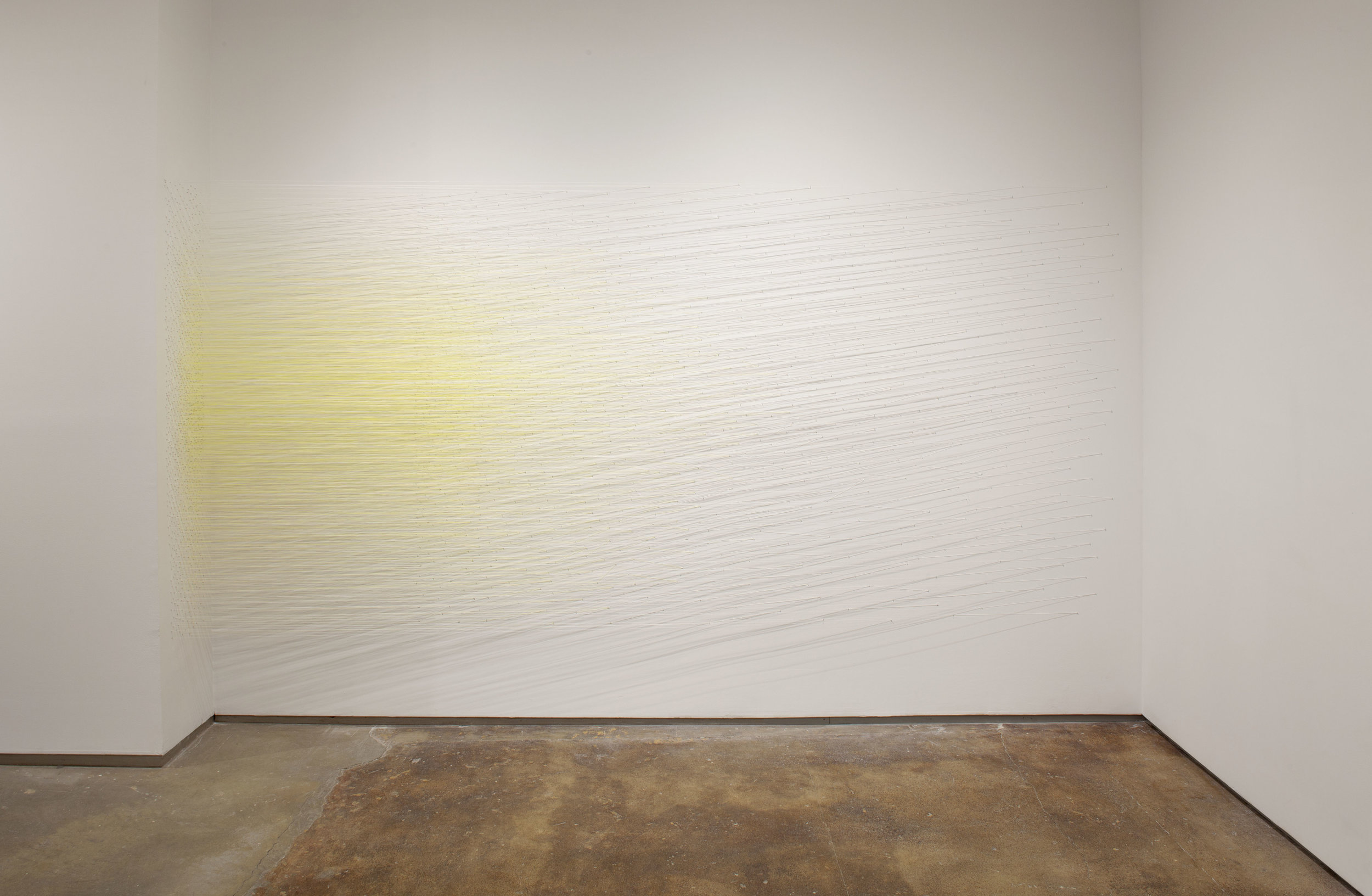
Anne Lindberg, murmur, 2018 cotton thread & staples, 60h by 140w by 14d inches
microwave, x opens at Josee Bienvenu Saturday December 22 from 11am-2pm in NYC
microwave, x
December 15, 2018 – January 26, 2019
Brunch reception: December 22, 2018 from 11am to 2pm
http://www.joseebienvenugallery.com/exhibitions/microwave-x
"No pretext, no effect, no message: microwave identifies an international group of artists who deliberately reduce their movements and expressive media. These artists imperceptibly move their fingertips to create works of precision and minimal displacement in a quasi-monochromatic context: syntheses and syntactics that recall the reductionism of genetic maps or binary codes. But this intimacy doesn’t require mouse or keyboard, it is a dialogue of fingertips: art positively digital. The works stand on the borderline between drawing, knitting and writing. A meticulous discipline of the close-up at the antipodes of the instantaneous and the remote control." (microwave, one, catalogue, 123 Watts, 1999)
Jonathan Callan
Romany Everleigh
Celeste Fitcher
Adam Henry
Anne Lindberg
Marco Maggi
Alicia Mihai Gazcue
Liliana Porter
Jonathan Rider
Sam Roeck
Ana Tiscornia
Richard Tuttle
Cy Twombly
Luis Urculo
Beto de Volder
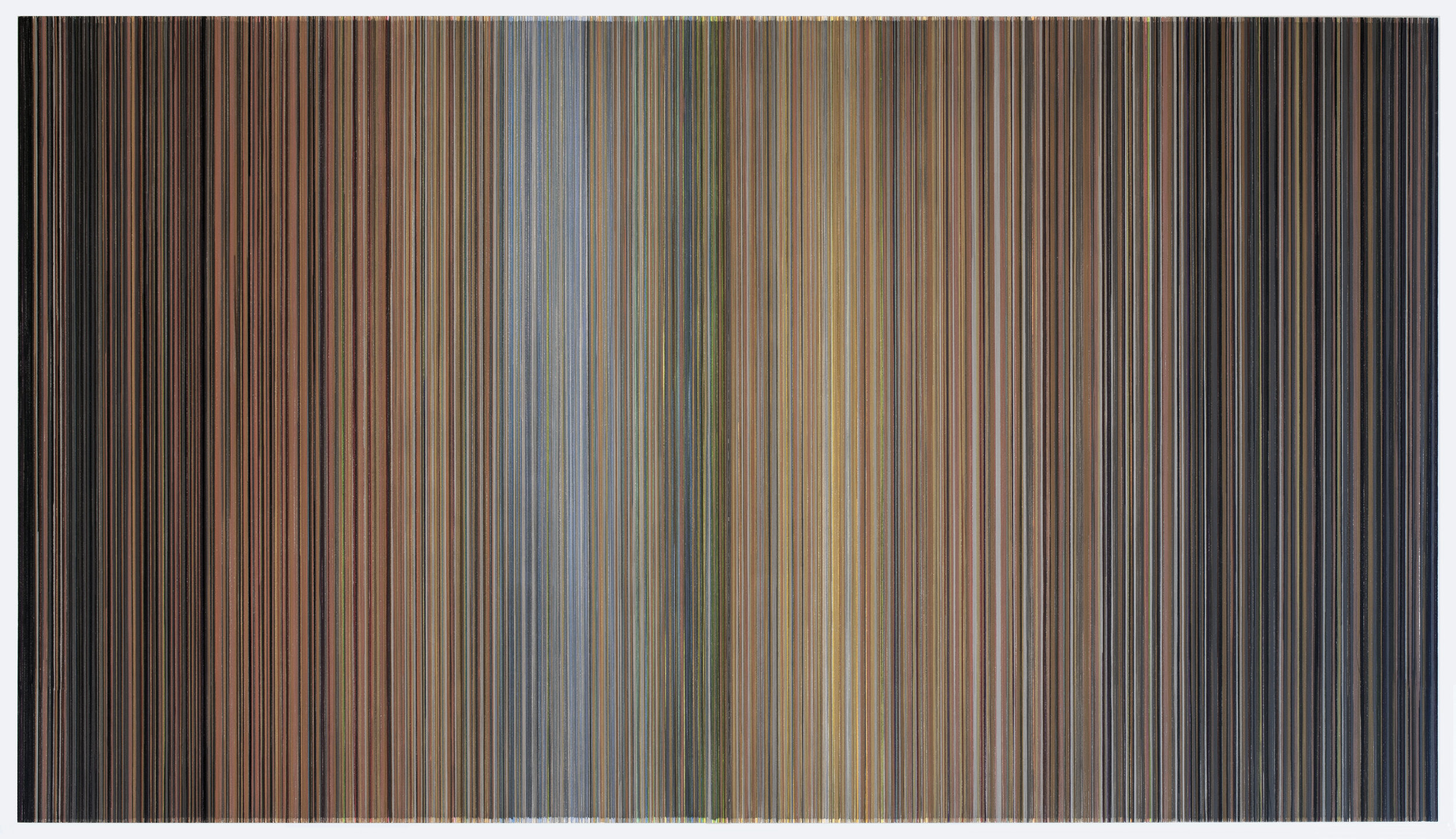
Anne Lindberg, It steals upon you when it steals upon you, 2018 graphite and colored pencil on mat board, 59 by 103 inches - title from Verlyn Klinkenborg’s More Scenes from Rural Life, Princeton Architectural Press, 2013, page 175
Still Life @SEPTEMBER opens Saturday, September 8th in Hudson, NY
STILL LIFE
Opening: Saturday, September 8, 6-8pm
Exhibition: September 8 - October 28, 2018
urated by Kristen Dodge and Candice Made
Theodora Allen
Julia Bland
Jamie Israelow
Anne Lindberg
Kate Newby
Jenny Perlin
Nori Pao
Carrie Schneider
Letha Wilson
SEPTEMBER is pleased to present a group exhibition entitled Still Life, co-curated with Candice Madey, including works by Theodora Allen, Julia Bland, Jamie Israelow, Anne Lindberg, Kate Newby, Jenny Perlin, Nori Pao, Carrie Schneider, and Letha Wilson.
Still Life refers to the transcendalist notion that we must look for a long time before we see, and that slowness is essential to science, philosophy, poetry, and by extension, a deeper understanding our world.
Traditionally an arrangement of perishable objects, such as fruits, flowers, wine, meats and cheeses, the still life is immortalized by the artist’s hand before the flowers wilt, fruits brown, wine turns, and foods sour. Intent observation and delicate execution, informed by years of study, apprenticeship, and experience bring the image close to life.
Rather than depicting the traditional genre of still life, these artists employ materials and processes to relate the landscape through extracts and arrangements of plants, earth, planets, and archetypes. Observation, repetition, ritual, and deliberate execution informs and comprise the fabric of their works. References to land suggest expanded ideas of temporality and measure as meditation; lost in the immensity of geological time or the awe-inspiring aspirations of the landscape genre.
Beautifully rendered abstractions of nature and the cosmos belie stauncher ideals associated with a synchronous slower pace, proposing that measured observation and reflection can be an act of protest and defiance in an age of rapid acceleration and hasty politics.
Here, there is an active hold on life; preserving what we love of the present, no eye to how it may devolve. There is still life.
For further information, please visit the gallery, our website, or contact Kristen Dodge at Kristen@septembergallery.com. SEPTEMBER is located at 449 Warren Street in Hudson, NY.
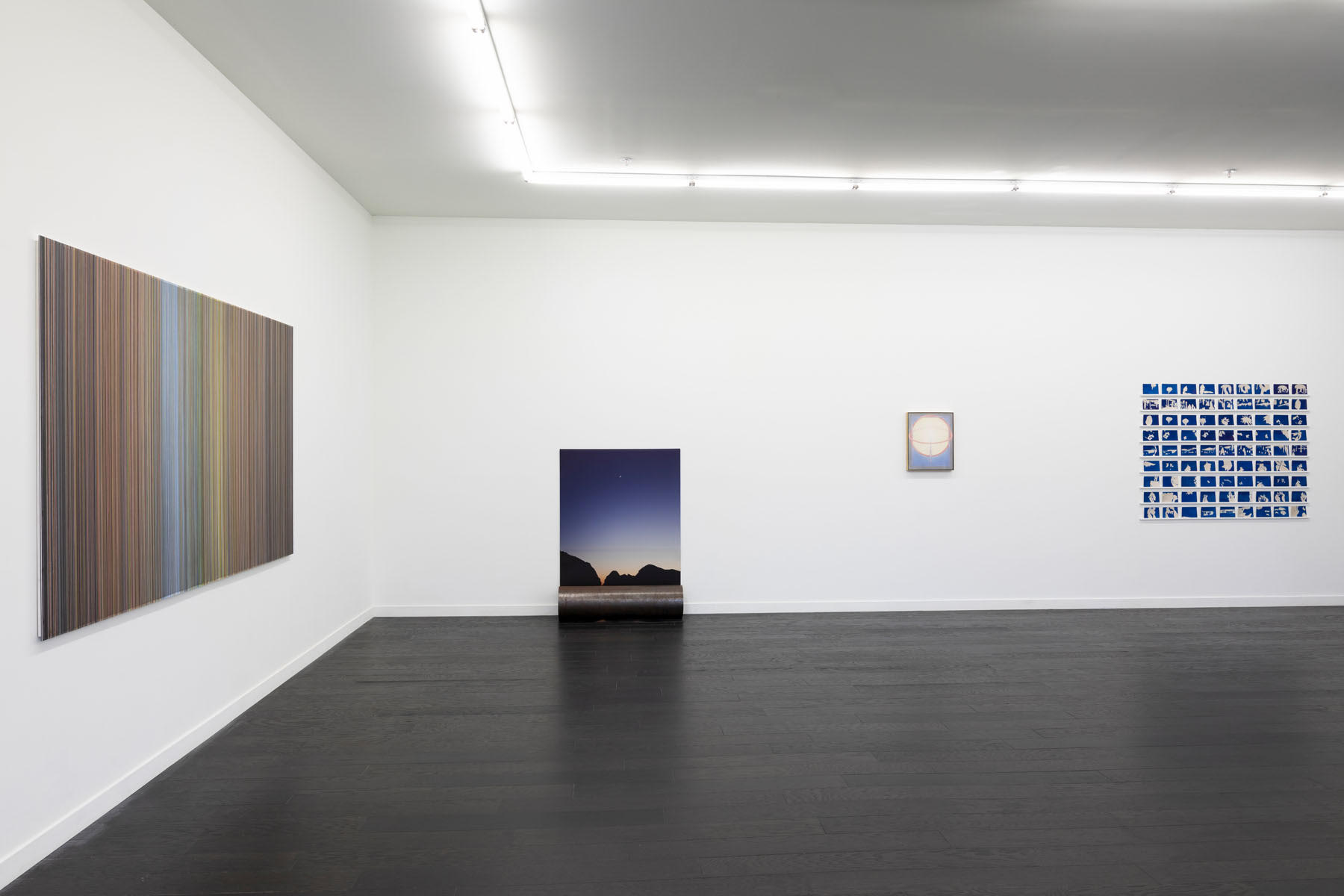

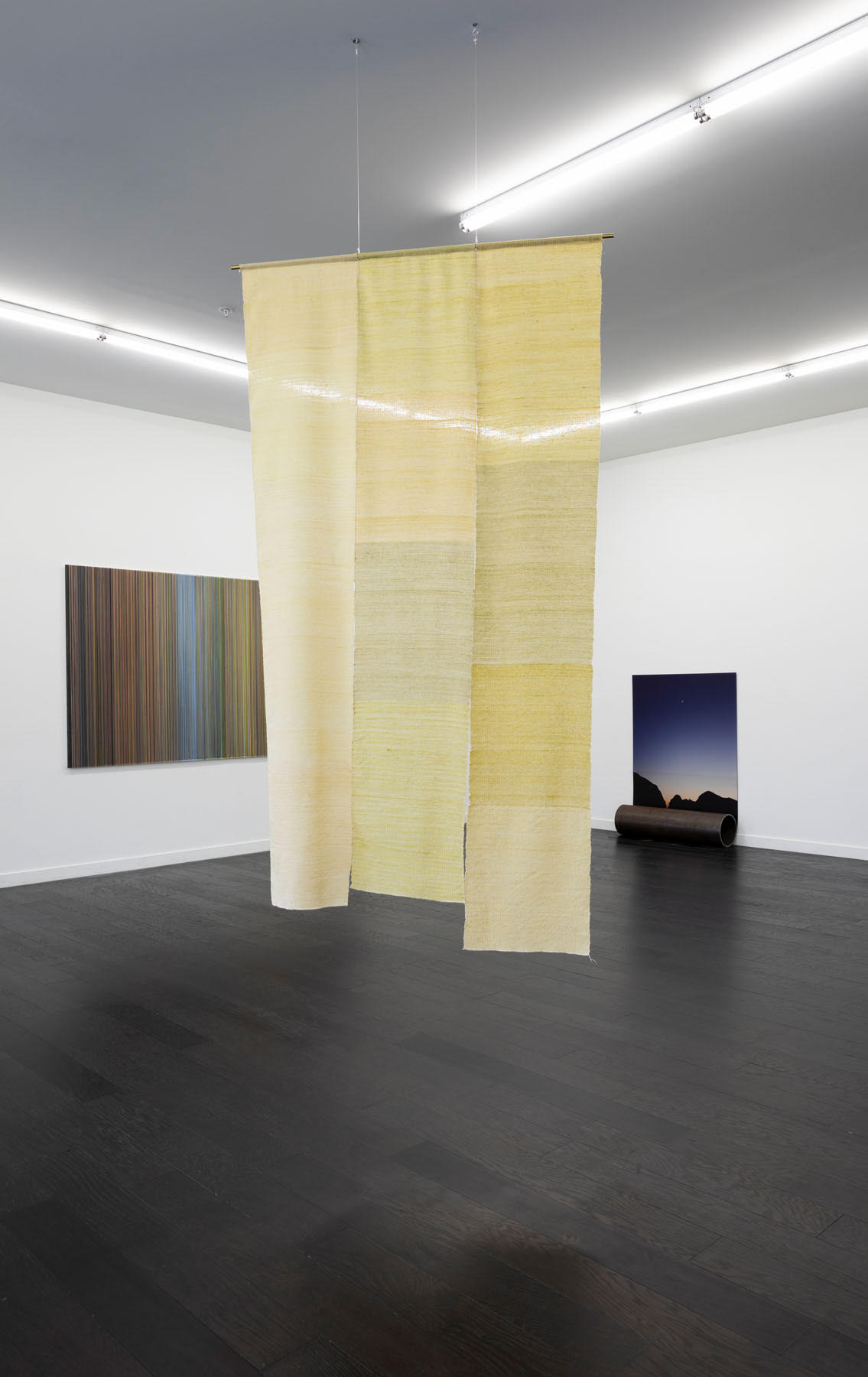

Spectrum, curated by Kate Menconeri and Kiki Smith, opens at the Thomas Cole National Historic Site Saturday August 25
Anne Lindberg - Unto the East again, 2018 graphite and colored pencil on mat board, 20 by 50 inches; title is from Emily Dickinson’s poem It sifts the Leadon Sieves – (291)
THOMAS COLE SITE PRESENTS SPECTRUM, A SITE-SPECIFIC CONTEMPORARY ART EXHIBITION THAT EXPLORES RELATIONSHIPS BETWEEN THOMAS COLE’S USE OF COLOR AND THAT OF 11 CONTEMPORARY ARTISTS
SPECTRUM is an exhibition of contemporary artworks installed throughout the historic home, studios, and grounds at the Thomas Cole National Historic Site and is part of the ongoing series OPEN HOUSE: Contemporary Art in Conversation with Cole. The exhibition is on view August 14 through November 18, 2018 and grew out of conversations between the Cole Site curator Kate Menconeri, the artist Kiki Smith, and exhibiting artists who include Polly Apfelbaum, Valerie Hammond, Ann Veronica Janssens, Anne Lindberg, Laura Moriarty, Portia Munson, Jackie Saccoccio, Lisa Sanditz, Julianne Swartz, Mildred Thompson, and Linda Weintraub.
ON VIEW AT THOMAS COLE SITE August 14 - November 18, 2018
+ Opening Reception with Artists: Saturday, August 25, 2018, 4-6 pm
Catskill, NY – August 1, 2018 – The Thomas Cole National Historic Site announced today a new contemporary art exhibition SPECTRUM, opening August 14, that brings together the work of 11 contemporary artists that will be installed throughout the 19th-century historic home, studios, and grounds of the artist Thomas Cole (1801-1848).
The project is inspired by and in dialogue with Thomas Cole's own work, spanning the interior colors he carefully chose for the house, his own color wheel painting titled Diagram of Contrasts, and his extensive writing on the topic of color,which details his desire to invent an instrument that could play the sound of color. The historic site’s 1815 Main House also contains the earliest-known interior decorative painting by an American artist, and its bold features reveal an addeddimension to Cole’s use of and thinking about color.
SPECTRUM will feature more than 30 new and existing artworks and installations, alongside Cole's work, that are made by 11 contemporary artists: Polly Apfelbaum (Elizaville, NY and New York City); Ann Veronica Janssens (Brussels, Belgium); Valerie Hammond (New York City); Anne Lindberg (Ancramdale, NY); Laura Moriarty (Rosendale, NY); Portia Munson (Catskill, NY); Jackie Saccoccio (West Cornwall, CT); Lisa Sanditz (Tivoli, NY); Julianne Swartz (Stone Ridge, NY and New York City); Mildred Thompson (deceased; Atlanta), and Linda Weintraub (Rhinebeck, NY). Many of the exhibiting artists have international careers but maintain deep local ties to the Hudson River Valley, as did Cole.
All works will be presented in a new site-specific context, in which they have never-before been shown, and carefully placed to be in conversation with Cole and the unique historic rooms and grounds of the 19th-century artist's home and studios. The diverse projects on view examine color in relation to smell, sight, and taste, as well as music, emotion, science, abstraction, and the natural world.
The contemporary artworks will include an immersive site-specific light installation by Ann Veronica Janssens, a garden designed by Portia Munson, woodblock prints by Polly Apfelbaum, Camera-Less-Videos by Julianne Swartz, an outdoor rainbow by Valerie Hammond, vibrant Radiation Explorations by Mildred Thompson, and monumental scaled works on linen by Jackie Saccoccio. The artist Lisa Sanditz is creating for the occasion an installation of sculpture and painting, combined with works from the Cole Site’s collection by Emily Cole (Thomas Cole’s daughter), and Anne Lindberg is presenting a new site-specific thread installation and works on paper that respond to Thomas Cole's periwinkle wall-color choice. Laura Moriarty created a "Tableau for Thomas Cole " with pigmented beeswax, and Linda Weintraub will present an installation of home-preserved food in the order of the color spectrum.
“Thomas Cole was fascinated by how color connects to music, to emotion and the natural world,” said Kate Menconeri,curator. “This exhibition explores that fascination through contemporary eyes – those of artists who are expanding our experience and understanding of color two centuries later. Simultaneously they, like Cole, explore color at the intersection of art and science, and as both light and pigment.”
The genesis of the exhibition grew out of ongoing conversations between Cole site curator Kate Menconeri and artist Kiki Smith while working on Smith's 2017 solo exhibition From the Creek at the Thomas Cole Site.
Cole once wrote in his journal that “colours are as capable of affecting thee by combination, degree, and arrangement assound.” Drawing on such ideas, the exhibition also explores Cole’s use of and thinking about color through his own texts, publications of his time, and new writing by artist and NYU Art Department Chair Jesse Bransford, that offers an overview of the historic context and color theories that Cole was exploring in the 19th century. An exhibition catalogue will feature this new text as well as artists’ pages and en-situ views of the contemporary installations. The exhibition is supported by the New York State Council on the Arts with the support of Governor Andrew M. Cuomo and the New York State Legislature and Empire State Development’s I LOVE NEW YORK program under the Market NY Initiative.
ABOUT OPEN HOUSE: Contemporary Art in Conversation with Cole: SPECTRUM is the third annual exhibition in this series, which is an annual presentation of curated contemporary art installations that are sited within and around the historic home of the artist Thomas Cole. Operating from the concept that all art is contemporary, the program activates
conversations between artists across the centuries and is collaborative by nature. Each year the Thomas Cole Site invites one or more contemporary artists to create a site-specific project that engages with the art, writings, home, and story of Thomas Cole. Projects may take the shape of an installation, a performance, a guided walk, or other format reflectingthe artist’s practice and ideas. This program seeks art and ideas of the highest artistic merit, drawn from newly created or relevant pre-existing works, that shed light on the connections between 19th-century American art and contemporary times, and that specifically speak to the historic environments in which they are presented.
THE THOMAS COLE NATIONAL HISTORIC SITE is an international destination presenting the original home and studios ofThomas Cole, the founder of the Hudson River School of painting, the nation’s first major art movement. Located on 6acres in the Hudson Valley, the site includes the 1815 Main House; Cole’s 1839 Old Studio; the recently reconstructedNew Studio building; and panoramic views of the Catskill Mountains. It is a National Historic Landmark and an affiliated area of the National Park System. The Cole Site’s activities include guided tours, special exhibitions of both 19th-century and contemporary art, printed publications, extensive online programs, activities for school groups, free community events, lectures, and innovative public programs such as the Hudson River School Art Trail—a map and website that enables visitors to visit the places that Cole painted. The goal of all programs at the Cole Site is to enable visitors to findmeaning and inspiration in Thomas Cole’s life and work. The themes that Cole explored in his art and writings—such as landscape preservation and our conception of nature as a restorative power—are both historic and timely, providing the opportunity to connect to audiences with insights that are highly relevant to their own lives. The program grew out of the 2015 exhibition River Crossings: Contemporary Art Comes Home, curated by Stephen Hannock and Jason Rosenfeld.
Topologies at The Warehouse Dallas on view until late December 2018
I'm delighted to announce that my work that is in the Howard and Cindy Rachofsky Collection is part of terrific exhibition Topologies curated by Mika Yoshitake at The Warehouse Dallas.
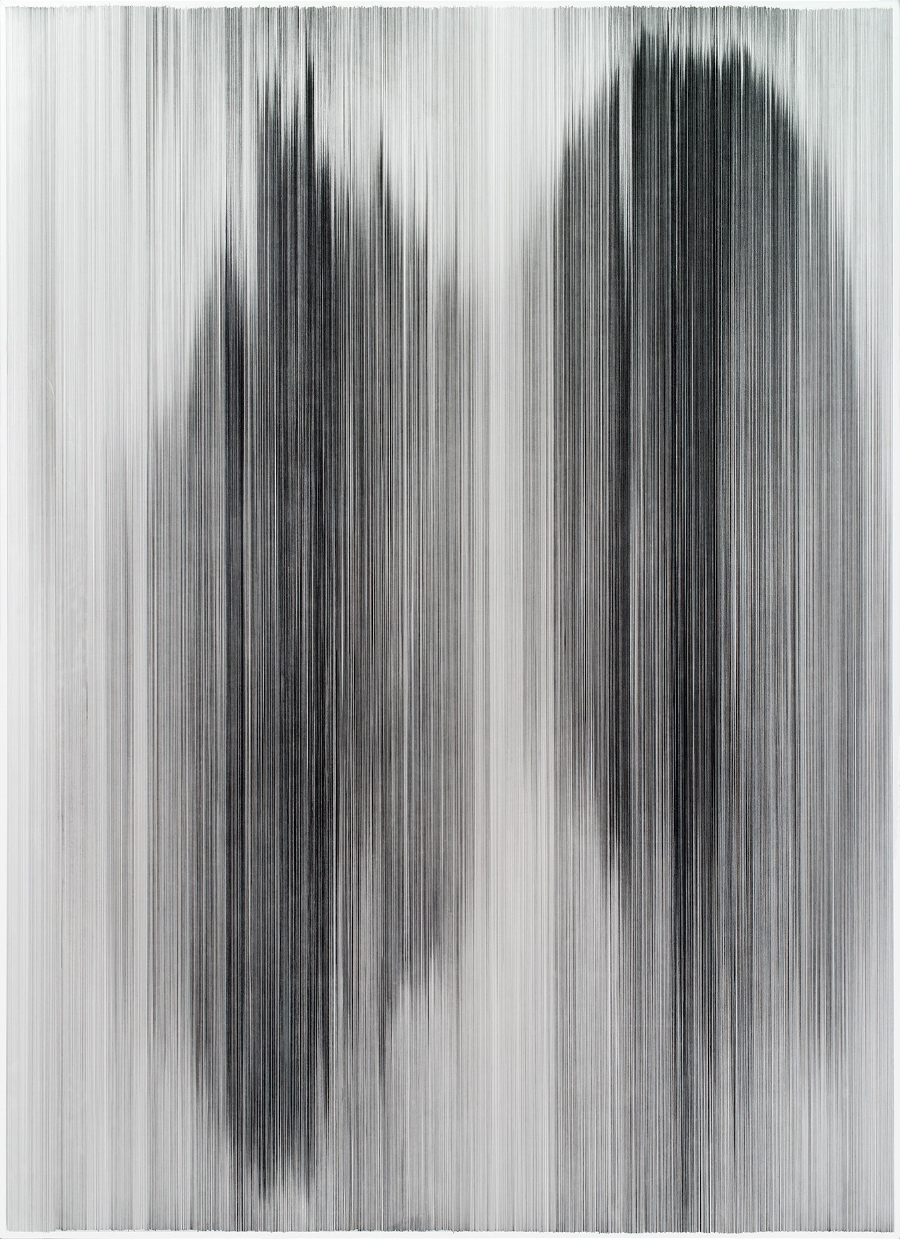
Anne Lindberg, parallel 38, 2013 graphite on cotton mat board, 80 by 60 inches, photography by EG Schempf, Howard and Cindy Rachofsky Collection
Artists throughout the post–World War II period have been fascinated by the ways in which space can be activated. One key model has been the notion of topology (“logic of place”), which centers on the concept of geometric transformation, in which space and shape can be expanded, contracted, distorted, and twisted while the structure of the object remains constant throughout.
Taking this definition as a launching point, topology appeared in postwar art in the late 1960s. A turn away from the fixed structures of Euclidean geometry and empiricism, topological properties as applied in art include connection via a breakdown of boundaries, the use of open structures, and a cross-pollination of disciplines that questions systems of knowledge. Movement and change, rather than a static object itself, constitutes the artwork. Topologies demonstrates how this mathematical field and its implications came into use by visual artists who were expanding systems-based practices in a variety of media around the world.
Two conceptions of topology by artists whose works are on view at The Rachofsky House provide key axes to this exhibition. In Japan, the idea was interpreted through a physics of form foundational to the Mono-ha group’s breakthrough Land art piece Phase—Mother Earth (1968) by artist Nobuo Sekine, which operates on a continuous renewal of perception through a cycle of creation and recreation. In the United States, artist Dan Graham introduced topology in his seminal essay “Subject Matter” (1969), describing perceptual effects in process-based practices in which “the spectator’s visual field . . . shifts in a topology of expansion, contraction, or skew.” Together, these ideas from different parts of the world establish the radical significance of the idea that form may remain continuous despite changes that occur over time.
Gathering more than 100 works created between 1952 and 2016 by 61 artists, Topologies offers both snapshots of particular moments in time and historical lineages that unfold over years. It draws from The Rachofsky Collection’s strong formal and conceptual holdings on international practices that emphasize process and materiality. The show expands on themes including permutation and distortion in space, inversions and other shifts in the body’s phenomenological relationship to space, material transition based on gravity and entropy, the politics of displacement, and reconceiving abject encounters between the synthetic and organic.
Topologies draws works from The Rachofsky Collection, the Dallas Museum of Art, Deedie Rose, and Jennifer and John Eagle.
Mika Yoshitake, Exhibition Curator
ARTISTS:
David Altmejd
El Anatsui
Janine Antoni
Leonor Antunes
Mel Bochner
Alighiero Boetti
Geta Bratescu
Alberto Burri
Chung Chang-Sup
Alice Channer
Lucy Dodd
Kōji Enokura
Luciano Fabro
Peter Fischli / David Weiss
Lucio Fontana
Helen Frankenthaler
Marcius Galan
Felix Gonzalez-Torres
Ann Hamilton
Rachel Harrison
Minoru Hirata
Jim Hodges
Shirazeh Houshiary
Pierre Huyghe
Park Hyunki
Akira Kanayama
On Kawara
Lee Kun-Yong
Yayoi Kusama
Liz Larner
John Latham
Annette Lawrence
Barry Le Va
Seung-Taek Lee
Anne Lindberg
Dashiell Manley
Cildo Meireles
Marisa Merz
Natsuyuki Nakanishi
Bruce Nauman
Hitoshi Nomura
Shinro Ohtake
Gabriel Orozco
Kiyoji Otsuji
Sigmar Polke
Robert Rauschenberg
Pipilotti Rist
Analia Saban
Shozo Shimamoto
Fujiko Shiraga
Frances Stark
Jiro Takamatsu
Cheyney Thompson
Rikrit Tiravanija
Gunther Uecker
Lee Ufan
Paloma Varga Weisz
Tsuruko Yamazaki
Toshio Yoshida
Kwon Young-Woo

the eye's level, 2018 digital rendering by Elvis Achelpohl for solo exhibition at the Museum of Arts and Design, opening 18 October 2018
the eye's level, a solo exhibition @ the Museum of Arts and Design opens in mid-October 2018
About the Exhibition
Anne Lindberg is a Hudson Valley-based artist working in the expanded field of drawing. Making installations and drawings that consider the landscape of body and space, her work provokes emotional, visceral and perceptual responses to light, architecture, time, movement and color. Interested in the relationship between deep thinking and composing, especially as the latter develops and unfolds through walking, Lindberg forefronts movement as a significant component in her making, characterizing her studio practice a paced and daily conversation with place.
Using heavyweight, colored thread, drawn taut through a space, Lindberg expands both fiber and drawing practices into the spatial and architectural realms. the eye’s level, Lindberg’s new site-specific installation for The Museum of Arts and Design, is her first solo exhibition in a New York City museum and furthers her investigation into the building of color fields from the accumulation of thread-as-line, stitched, so-to-speak, into the walls.
Lindberg’s installations appear like hovering clouds of color suspended in air, a formal accomplishment that considers the light, architecture and movement around and through a site. Each installation is built from thousands of thread lines, held in tension between two points. The process of installation is made visible to the viewer, as Lindberg walks the thread across the space – scaling up, and making bodily, the act of drawing.
the eye’s level pairs a new installation, composed in pearlescent tones to build a shimmering, luminescent field, with one of Lindberg’s large-scale pencil drawings on matte-board. The effect is that of a raking light, cutting across the gallery, making material and fixing in time, the sensation and effect of a cool ray of mid-morning light.
the eye’s level by Anne Lindberg is curated by MAD’s William and Mildred Lasdon Chief Curator, Shannon R. Stratton with assistance from Assistant Manager of Curatorial Affairs Angelik Vizcarrondo-Laboy.
the long sun, a solo exhibition of new work by Anne Lindberg opens at CAM Raleigh, February 2, 2018
the long sun, a solo exhibition of new work by Anne Lindberg opens at the Contemporary Art Museum in Raleigh, NC on Friday February 2, and runs through June 10, 2018
“Is honey the living equivalent of gold? Supposing one tried to give temperatures to colors. In a sense, we do it all the time when talking about warm and cool ones. A certain Red is 98 degrees C, Ultramarine is 7 degrees C, Cobalt Blue is -10 degrees C etc. Maybe yellow is the one color which is body temperature 37 degrees C. And so, the ancient Egyptians believed it was the color of immortality. You are struck by the fact that yellow is never regular, it’s varied. As you say it stores and reflects light, but it receives and gives off waves
which are not constant – as though its surface is liquid rather than solid.
And this irregularity reminds us of living skin…of a body.”
From I Send You This Cadmium Red – a correspondence between
writer John Berger and John Christie
Barcelona : ACTAR, in collaboration with MALM 2000
Anne Lindberg’s new solo exhibition the long sun brings light, materiality and rhythm to ruminations on the sun in context, eliciting qualities that are optical and spatial, emotional and tangential.
Lindberg cites a long tradition of the relationship of deep thinking and creating to time spent walking – connecting this practice to Henri Rousseau, William Wordsworth, Robert Walser and Virginia Woolf. the long sun expounds on the seamless relationship between the pace of her step and the evolution of the work in both two and three dimensions. Thousands of lines are pulled across a pliant mat board and cast between walls while walking. This work carries with it a quiet reserve, emotional power, and formal abstraction, building a gradient light, with a slow and telling use of tone to find meaning.
Lindberg studio time is a paced and daily conversation with place, in body and mind. From her studio in the Hudson River Valley, elements of light, space, and time coalesce from this understanding. As this work generates fundamental questions about time, causality and sequence, Lindberg speaks in an essential way to the human condition. the long sun presents a visual and bodily experience that conjoins personal and abstract voices with a sense that alchemy can exist in everyday life.
http://camraleigh.org/exhibitions/
Below are images of the drawings - installation shots will be added as soon as the custom work is completed in the gallery (week of January 25 - Feb 1)
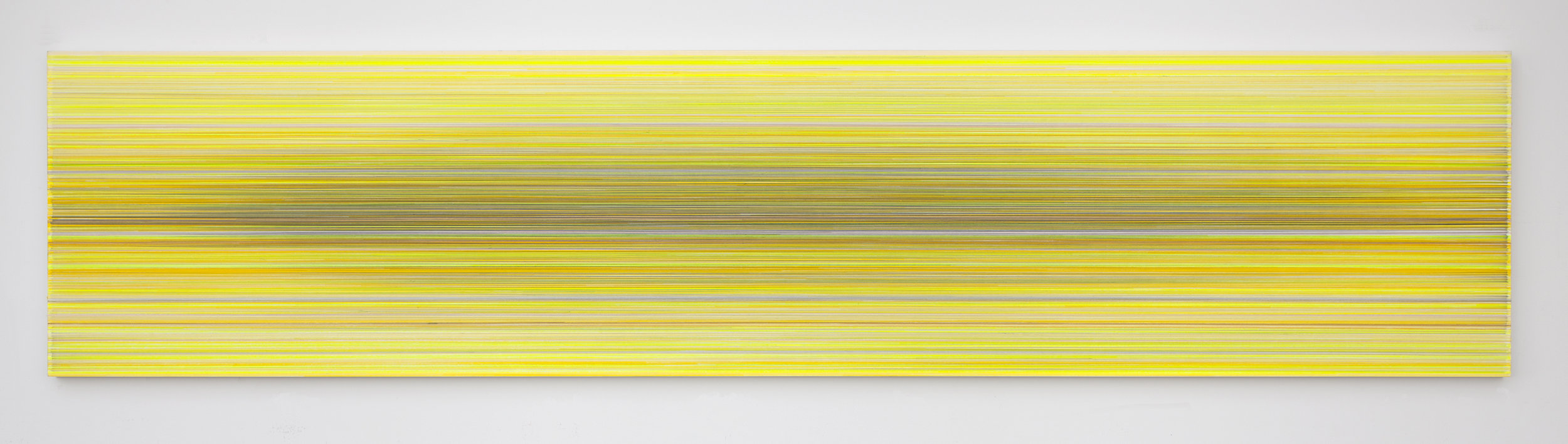

Anne Lindberg, "linen drawing 01," 2011 graphite on cotton mat board, 42 by 24 inches
good news. opens at Josee Bienvenu Gallery (NYC) Thursday, July 28 thru August 29
good news.
July 28 - August 29, 2016
Ricardo Alcaide
Abdulaziz Ashour
Ernesto Caivano
Darío Escobar
Fernanda Fragateiro
Simryn Gill
Anne Lindberg
Yuri Masnyj
Julianne Swartz
Yuken Teruya
Rirkrit Tiravanija & Tomas Vu
Adam Winner
July 28 - August 29, 2016
Opening reception: Thursday July 28, 6pm to 8pm
Summer hours: Monday to Friday 10am - 6pm
Josée Bienvenu is pleased to present good news., an exhibition of international artists working on and off paper to deconstruct and reconfigure information. With the daily deluge of bad news at our fingertips, we become disoriented in our distanced yet simultaneously intimate sense of connectedness to the world.
Based in Sao Paulo, Ricardo Alcaide interested in the social aspects of architecture and design. His interest in geometric abstraction, modernist constructions, and dynamics in urban centers allow him to juxtapose the poetic and the political. In his Intrusion series, Alcaide hinders the pictorial and symbolic reality of luxurious spaces by introducing a foreign element to pages of design magazines.
Based in Jeddah, Saudi Arabia, Abdulaziz Ashour presents international newspapers that have been altered by communication officials, as well as new sanded collages made during his recent residency at the Josef and Anni Albers Foundation in Connecticut. Ashour’s gestures add another layer of obscurity, questioning the power of the image as a means to convey underlying ideology.
Argentine American artist Ernesto Caivano lives and works in New York. He presents a panoramic work and abstract drawings that form part of a post-anthropocentric narrative titled After the Woods. Caivano's intricate drawings take their cues from cosmology, mythology, philosophy, romantic poetry, science fiction, Japanese printmaking and fractal geometry.
Darío Escobar lives and works in Guatemala City. He presents a new series of graphite and cinnabar clay compositions. His work is characterized by the revitalization of materials charged with historical and symbolic meaning, reexamining Western art history and aesthetics from a Guatemalan perspective.
Fernanda Fragateiro lives and works in Lisbon, Portugal. Her works are characterized by a keen interest in re-thinking and probing modernist practices. Fragateiro frequently employs the method of repurposing already-existing and symbolically layered material, such as second-hand books and magazines, in order to fashion complex yet delicate work that is criss-crossed by an intricate web of inner references to art theory and architectural history.
Singaporean-born artist Simryn Gill was educated in India and the UK, and now lives and works in Sydney and Malaysia. Included in this exhibition are the studies of her Let Go, Let's Go series of collage drawings on paper, presented at the Australian Pavilion at the 55th Venice Biennale in 2013. Several of her works involve erasing or excising the printed word in a microcosmic struggle with authority as embodied by canonical texts.
Anne Lindberg’s works tap a non-verbal physiological landscape of body and space, provoking emotional, visceral and perceptual responses. She works with an expanded definition of drawing languages that reside between abstraction and metaphor. Her graphite drawings are optical, sensual and metaphysically charged.
Ukrainian American artist Yuri Masnyj lives and works in New York. Masnyj's drawings focus on the aesthetic of historical avant-garde, in particularly Russian Constructivism, combining elements inspired by graphic design, architecture, and the art-historical past. Commenting on the ways that the avant-garde has filtered into the mainstream, tempering its utopian spirit, Masnyj's work alludes to the institutionalization and domestication of these once-radical forms.
Born in Phoenix, Julianne Swartz lives and works in upstate New York. Her sculpture Stability Study (bowl), explores negative space and the interface between outside and inside. Her work encourages a quizzical reconsideration of our relationship to our body and our surroundings, a metaphoric investigation of the limitations, fragility and endurance of the body, and the weight of human relationships.
Born in Okinawa, Japan, Yuken Teruya lives and works in New York. Teruya manipulates everyday objects, transforming their meanings to reflect on contemporary society and culture, creating micro universes that pertain to broader concerns. Teruya’s Minding My Own Business series features old New York Times newspapers that have been meticulously sliced open to sprout delicate plant life, adding a nuanced narrative to dismal front page news that seldom gives attention to ecological matters.
Rirkrit Tiravanija and Thomas Vu collaborate on a series titled Green Go Home, it is part myth, part misunderstanding and part imagination. Tiravanija extends from the notion of relational aesthetics, and Vu's work plays with the roles of man and machine and the waning boundary between the two.
Adam Winner is an American artist based in Brooklyn. Made with dense layers of oil on paper, Winner’s sculptural paintings expose their own accidents and mistakes, laying bare the edges and seams. Exploring imperfect gestures and the manifestation of internal conflict, his drawings are imbued with a sense of self-doubt, yet with confident control over the materials.
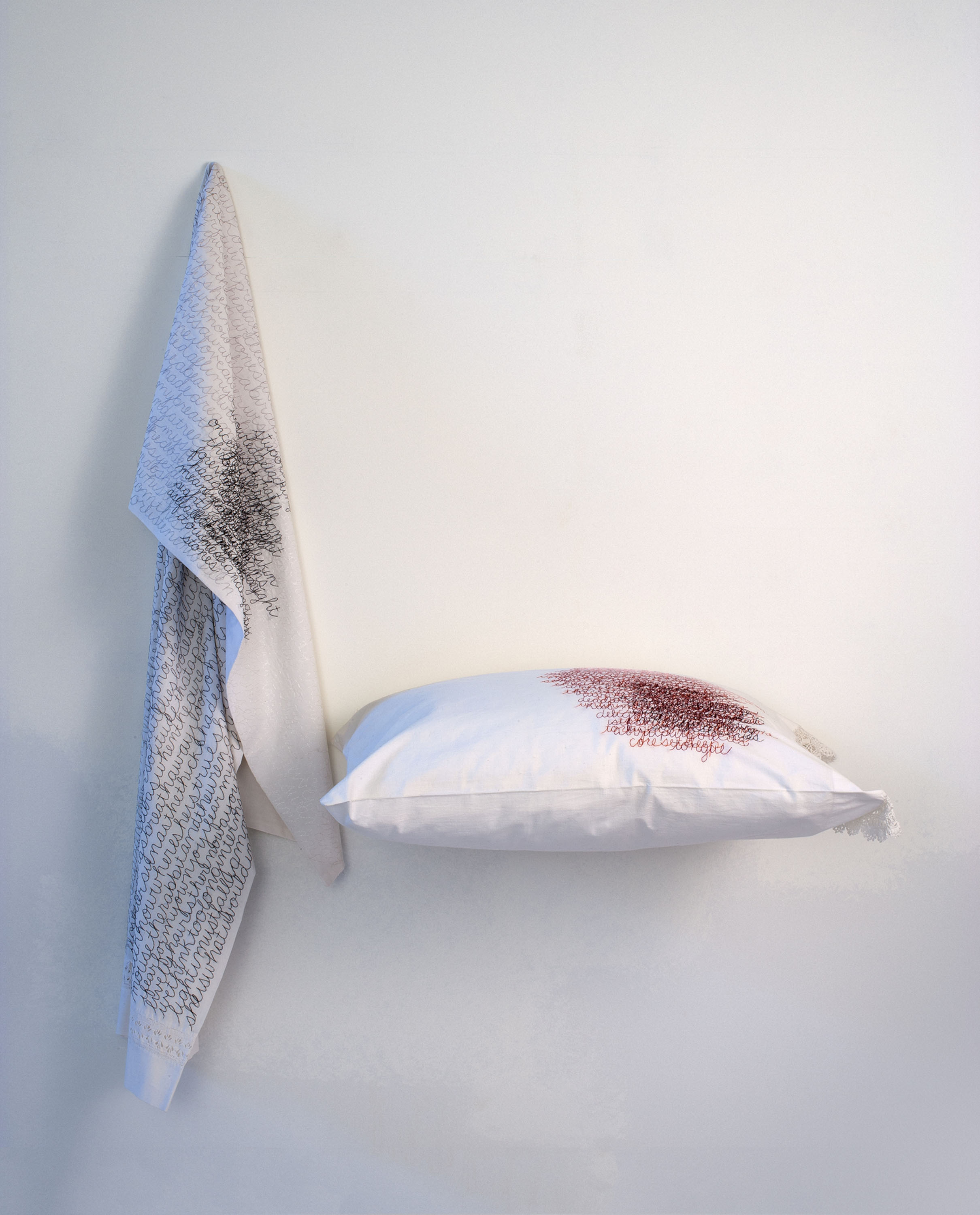
Anne Lindberg sleep, 2005 (reconfigured in 2012) rayon thread, pillow cases, 60 by 48 by 24 inches
Sleepless Nights, curated by Abigail Solomon-Godeau @ Galerie Hubert Winter, Vienna Austria, opens October 3, 2014
I am pleased announce that my work (including the above sculpture called "sleep" and 4 drawings from the insomnia series) will be included in Sleepless Nights at Galerie Hubert Winter in Vienna, Austria. Curated by Abigail Solomon-Godeau, this exhibition is part of a city wide project called The Century of the Bed from Curated By_Vienna.
Here is an excerpt from Beatriz Columna's essay The Century of the Bed:
The Century of the Bed
by Beatriz Colomina
In what is probably now a conservative estimate, The Wall Street Journal reported in 2012 that 80% of young New York City professionals work regularly from bed. Millions of dispersed beds are taking over from concentrated office buildings. The boudoir is defeating the tower. Networked electronic technologies have removed any limit to what can be done in bed. It is not just that the bed/office has been made possible by new media. Rather new media is designed to extend a 100-year-old dream of domestic connectivity to millions of people. The city has moved into the bed.
How did we get here?
Industrialization brought with it the 8 hour shift and the radical separation between home and office/ factory, rest and work, night and day. Post-industrialization collapses work back into the home and takes it further into the bedroom and into the bed itself. Fantasmagoria is no longer lining the room in wallpaper, fabric, images, and objects. It is now in the electronic devices. The whole universe is concentrated on a small screen with the bed floating in an infinite sea of information. To lie down is not to rest but to move. The bed is now a site of action.
Between the bed inserted in the office and the office inserted in the bed a whole new horizontal architecture has taken over. It is magnified by the “flat” networks of social media that have themselves been fully integrated into the professional, business and industrial environment in a collapse of traditional distinctions between private and public, work and play, rest and action.
What is the architecture of this new space and time? What is the nature of this new interior in which we have decided collectively to check ourselves in? What is the architecture of this prison in which night and day, work and play are no longer differentiated and we are permanently under surveillance, even as we sleep in the control booth?*
The exhibitions within the framework of curated by_vienna: The Century of the Bed address these questions and raise new ones. The individual projects offer insight into the diverse artistic investigations with this topic, but also into different kinds of curatorial practices.
*Read the unabridged version of Beatriz Colomina’s essay in the publication, which will be published on the occasion of the opening of curated by_vienna: The Century of the Bed and contains contributions of all participating curators and galleries.